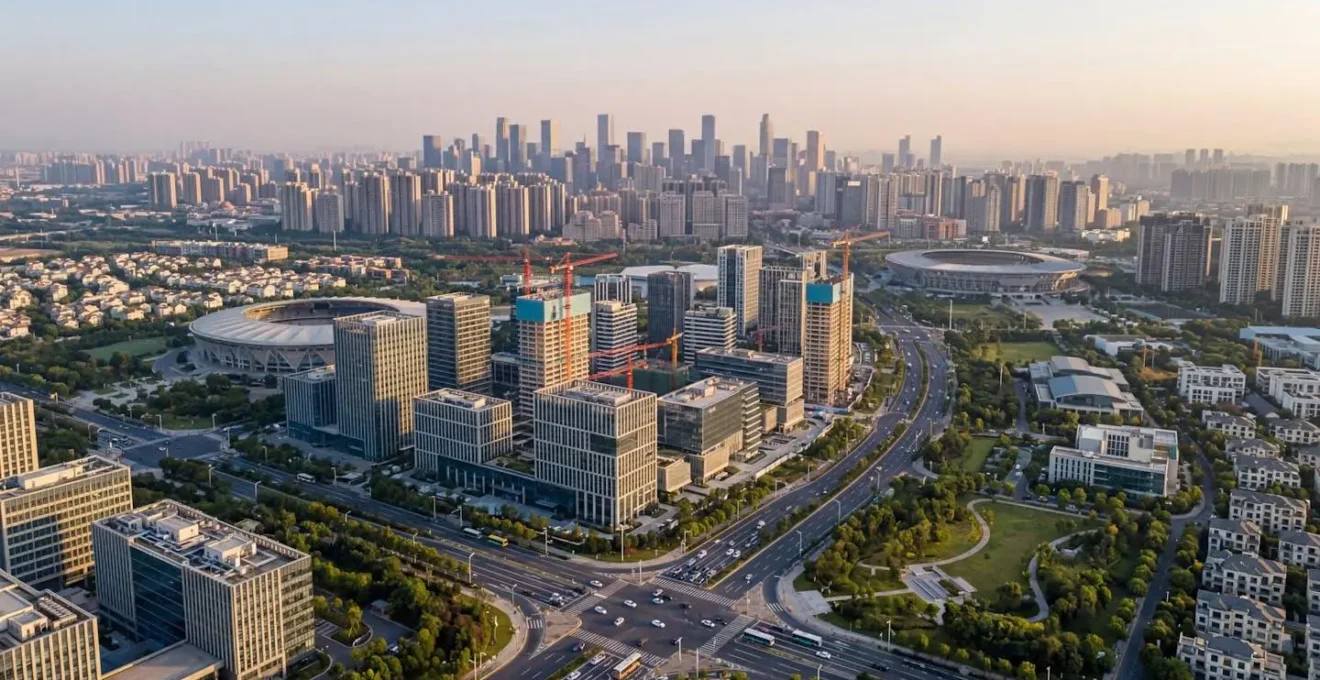
The conventional wisdom of investing in Australia’s major capital cities is outdated; the nation’s regional centers are now demonstrating a superior, more dynamic return on investment.
- They attract “smart capital”: a migration of skilled professionals, experienced entrepreneurs, and their established networks, not just population growth.
- Targeted infrastructure investment and agile local councils create a powerful economic multiplier effect that saturated metro markets cannot replicate.
Recommendation: Investors should shift their focus from overpriced capital city markets to these high-potential regional hubs to capture the next wave of Australian economic expansion.
For decades, the Australian investment playbook has been straightforward: focus on Sydney and Melbourne. These sprawling capitals were seen as the undisputed engines of the national economy, promising stable returns and endless growth. However, investors clinging to this outdated strategy are overlooking a fundamental structural transformation. The narrative of regional Australia as a mere lifestyle destination is being rewritten. These areas are rapidly evolving into dynamic economic powerhouses, offering a more compelling ROI than their congested metropolitan counterparts.
The conversation has moved beyond simply comparing property prices or operational costs. While those advantages remain, the true story lies in the convergence of powerful, often underestimated, growth drivers. The “tree change” phenomenon is no longer about a quiet retirement; it represents a significant transfer of intellectual and financial capital. This isn’t just population growth; it’s an influx of what can be termed ‘smart capital’—experienced executives, cashed-up entrepreneurs, and a skilled workforce demanding sophisticated local economies.
The key to unlocking superior returns is understanding that the true opportunity in regional centers is not just a discount, but a multiplier. This analysis will deconstruct the new economic equation of regional Australia. We will explore how targeted infrastructure projects are creating unprecedented connectivity, how agile local governance is outmaneuvering city bureaucracy, and how demographic shifts are creating deep, non-cyclical demand in key sectors. The question is no longer *if* you should invest beyond the capitals, but *how* you can strategically position yourself to capitalize on this irreversible economic shift.
This article provides a comprehensive analysis for investors, breaking down the key factors that make regional hubs the most intelligent long-term bet. The following sections will guide you through the data, trends, and strategic advantages that define this new investment frontier.
Summary: The New Playbook for Australian Investment
- Geelong, Newcastle, or Gold Coast: Which Satellite City Is the Next Big Thing?
- How New Rail Projects Are Transforming Regional Business Viability?
- Has the “Tree Change” Phenomenon Permanently Shifted Economic Power?
- How Regional Councils Are Outbidding Cities to Attract Business?
- Why Networking Is Faster and More Effective in Regional Centers?
- How AUKUS Is Reshaping the Manufacturing Landscape in South Australia?
- Why Are Regional Areas Desperate for Health and Education Professionals?
- Why Brisbane Is the Smartest Long-Term Bet for Property and Business?
Geelong, Newcastle, or Gold Coast: Which Satellite City Is the Next Big Thing?
The debate is no longer about regional centers versus capitals, but rather which high-growth satellite city will emerge as the dominant investment hub. Cities like Geelong, Newcastle, and the Gold Coast are not just benefiting from overflow from Melbourne and Sydney; they are generating their own powerful economic momentum. They have reached a critical mass of population, infrastructure, and industry diversity that allows them to compete on a national stage. This transformation is evident in their staggering growth metrics, which now consistently outperform the major capitals.
The Gold Coast, for example, is a prime case study in this economic maturation. Once viewed primarily as a tourism hub, its economy is diversifying at a remarkable pace. Recent economic analysis reveals a projected 10.07% cumulative GRP growth forecast for 2024-2028, a figure that leaves major capitals trailing. This isn’t a fleeting trend; the city’s economy grew almost twice as fast as forecast in 2023, positioning it as Australia’s fastest-growing economy in the post-pandemic era. This performance underscores a key investment thesis: these cities have developed resilient, multi-faceted economies that offer both growth and stability.
The mechanisms driving this expansion vary, creating distinct opportunities in each location. As this comparative table based on the latest government data shows, the drivers range from internal migration to a surge in overseas arrivals, each creating unique demands and investment prospects.
| Regional City | 2023-24 Growth Rate | Primary Growth Driver |
|---|---|---|
| Sunshine Coast | 2.4% | Internal Migration |
| Geelong | 2.3% | Internal Migration |
| Gold Coast | 2.3% | Net Overseas Migration (77%) |
For an investor, the task is to look beyond the national headlines and analyze the specific economic DNA of each of these rising stars. Understanding whether growth is driven by young families moving from a nearby capital or skilled migrants arriving from overseas is crucial to identifying the most lucrative opportunities in property, services, and local business. The race is on, and the returns will flow to those who correctly identify the next breakout star.
How New Rail Projects Are Transforming Regional Business Viability?
Infrastructure is the circulatory system of an economy, and for decades, regional Australia has been held back by arterial blockages. That era is definitively over. A new generation of transformative rail projects is not just reducing commute times; it is fundamentally redrawing the map of business viability. These projects act as a powerful economic multiplier, unlocking land value, enabling the creation of new commercial hubs, and facilitating a seamless flow of talent between regional centers and capital cities.
These are not minor upgrades. We are witnessing city-shaping investments, such as the Cross River Rail in Brisbane, which is part of a wider $100+ billion infrastructure pipeline transforming South-East Queensland. By improving connectivity, these rail lines make it feasible for a company to establish its headquarters in a regional center—benefiting from lower costs and a better lifestyle for employees—while maintaining easy access to the client base and talent pool of a major capital. This creates a “best of both worlds” scenario that was previously impossible.
The impact extends far beyond the tracks. New and upgraded stations are becoming catalysts for urban renewal, acting as anchor points for co-working spaces, retail precincts, and high-density residential developments. This creates a virtuous cycle of investment and growth.
As this visualization of a modern regional hub suggests, the train station is no longer just a point of transit but a destination in itself—a center of commerce and community. For investors, this means looking at the catchment areas of these new rail corridors as the next frontier for commercial and residential property development. The viability of a business is now measured in minutes by train, not kilometers by road, and this shift is creating immense value.
Has the “Tree Change” Phenomenon Permanently Shifted Economic Power?
The term “tree change” has often been dismissed as a fleeting lifestyle trend, a temporary exodus from the city in search of greener pastures. This is a profound misreading of the current economic landscape. The post-pandemic migration is not a retreat from the economy; it is a strategic redeployment of its most valuable asset: smart capital. This phenomenon represents a permanent and structural shift in economic power away from the centralized model of the 20th century.
The ‘tree change’ is a migration of experienced executives, serial entrepreneurs with established networks, and private investment capital
– Economic Analysis, Regional Economic Transformation Study
This migration consists of a different caliber of individual than in previous cycles. We are seeing seasoned professionals with decades of experience, entrepreneurs who have successfully exited businesses, and skilled workers who can now work from anywhere. They bring with them not just their families, but their professional networks, their investment portfolios, and an appetite for sophisticated local services. This influx of human and financial capital is the primary catalyst for the explosive growth in regional professional service firms, tech startups, and high-end consumer businesses.
Case Study: The Impact of Intellectual Capital Transfer
The Sunshine Coast provides a clear example of this trend’s real-world impact. The region has seen a 35% increase in companies employing more than 20 workers since 2019, overtaking major hubs such as the Gold Coast, Geelong and Newcastle. This demonstrates that the migration is not just of individuals, but of entire enterprises and the jobs they create. It is a direct result of skilled professionals moving to the region and either scaling existing businesses or establishing new ones, thereby transforming the local economic ecosystem.
This is not a reversal to a simpler life; it is the foundation of a more distributed, resilient, and dynamic national economy. For investors, this means the most valuable opportunities are no longer concentrated in CBD office towers but are now found in the growing professional service sectors, advanced manufacturing facilities, and lifestyle-focused businesses of regional Australia. The power has shifted, and a failure to recognize this is a failure to see where future returns will be generated.
How Regional Councils Are Outbidding Cities to Attract Business?
In the battle for business investment, major city councils are often hampered by bureaucracy, political inertia, and conflicting stakeholder interests. Regional councils, in contrast, have turned agility into their primary weapon. They are actively outbidding and outmaneuvering their metropolitan counterparts by offering a level of flexibility, speed, and direct access that large cities simply cannot match. This approach of agile governance is a significant, if often overlooked, factor driving superior ROI in regional investments.
This isn’t just about offering token tax breaks. Regional councils are engaging in bespoke public-private partnerships, fast-tracking approvals, and even co-investing in crucial last-mile infrastructure to secure major employers. An analysis by JP Morgan has shown that such proactive measures can lead to a positive ROI for new regional facilities within the first year. Business leaders often find they have direct personal access to key decision-makers, including mayors and planning directors, allowing them to resolve issues in days that would take months or years in a capital city.
This proactive, pro-business stance creates a highly favorable investment climate where timelines are compressed, and capital is deployed more efficiently. For any investor or business considering a significant move, evaluating a council’s tangible support measures is a critical part of due diligence.
Your Due Diligence Checklist: Assessing a Council’s Pro-Business Stance
- Permitting & Zoning: Inquire about fast-track permitting processes and the council’s flexibility on zoning for specific project needs. Can they provide clear timelines?
- Access to Leadership: Gauge your ability to engage directly with key decision-makers. Is the council leadership accessible and engaged in economic development?
- Partnership Models: Explore their willingness to create bespoke public-private partnerships. Are they open to tailored solutions beyond off-the-shelf grant programs?
- Infrastructure Co-Investment: Determine if the council is prepared to co-invest in essential infrastructure (e.g., road access, utility upgrades) required for your facility.
- Workforce Development: Assess their collaboration with local TAFEs and universities. Do they offer custom training programs to build a talent pipeline for major employers?
Ultimately, regional councils are winning because they can operate at the speed of business. They see new investment not as a planning problem to be managed, but as an economic opportunity to be seized. This partnership approach significantly de-risks projects and accelerates the path to profitability, forming a core component of the regional ROI advantage.
Why Networking Is Faster and More Effective in Regional Centers?
The dense, interconnected nature of a regional business community offers a powerful competitive advantage that is impossible to replicate in an anonymous major city. In a smaller ecosystem, networking is not a transactional exchange of business cards but a rapid process of building trust and reputation. This accelerated capital velocity—where ideas, opportunities, and influence move faster—is a key driver of business growth and a significant component of regional ROI.
In a smaller community, professional and social reputation is a powerful currency that is built and spread quickly
– Network Theory Analysis, Regional Business Networks Study
In a regional center, you are more likely to interact with the same key people across different contexts: at a Chamber of Commerce event, on the sidelines of a school sports game, or at a local cafe. This multi-layered interaction builds familiarity and trust far more quickly than formal meetings alone. A positive reputation becomes a valuable asset that precedes you, opening doors and fast-tracking decisions. The “six degrees of separation” often shrink to just one or two, meaning you can get a warm introduction to almost any key player in town with minimal effort.
This has tangible business benefits. Market intelligence is shared more freely, collaborations between businesses emerge more organically, and access to local leaders and investors is significantly democratized. A new business can establish itself and become a recognized part of the community fabric in a fraction of the time it would take in Sydney or Melbourne. This ability to quickly build social and political capital allows businesses to seize opportunities faster, solve problems more efficiently, and ultimately, grow more rapidly.
For an investor, this means that a portfolio company established in a regional center can achieve market penetration and influence far quicker than its metropolitan counterparts. The network itself becomes a strategic asset, amplifying the efforts of the business and accelerating its path to profitability. This is not a “soft” benefit; it’s a hard-edged competitive advantage.
How AUKUS Is Reshaping the Manufacturing Landscape in South Australia?
Mega-projects have the power to redefine a region’s economic identity, and few are more transformative than the AUKUS security pact for South Australia. This is far more than a contract to build submarines; it is a catalyst for creating an entire advanced manufacturing ecosystem from the ground up. The AUKUS program serves as a powerful illustration of the multiplier effect, where a single, large-scale investment seeds an entire landscape of high-value, specialized industries, creating deep and lasting economic strength.
The direct investment in shipbuilding is just the tip of the iceberg. To support this decades-long endeavor, a sophisticated network of Tier 2 and Tier 3 suppliers is emerging across the state. This creates a gravitational pull for expertise and investment in a host of related fields. We are seeing a surge in demand and innovation across cybersecurity, precision engineering, advanced logistics, artificial intelligence, and specialized technical training sectors.
Case Study: The AUKUS Economic Spillover
The AUKUS submarine program is creating an unprecedented ecosystem of specialized SMEs in South Australia. These are not just ancillary suppliers but world-class companies in their own right. The program’s stringent requirements are forcing an uplift in skills and technological capability across the board, establishing South Australia as a national leader in defense and advanced manufacturing. This demonstrates how a single mega-project can transform an entire regional economy, creating thousands of high-skilled jobs and a sovereign industrial capability that will deliver economic benefits for generations.
This ecosystem becomes a magnet for ‘smart capital’, attracting top engineers, technicians, and researchers from around the world. The presence of this talent pool then attracts further investment, creating a self-reinforcing cycle of growth and innovation.
For visionary investors, the opportunity is not just in bidding for prime AUKUS contracts. It lies in identifying and backing the innovative SMEs that form this new industrial ecosystem. These businesses, specializing in niche, high-tech applications, are the hidden gems of the AUKUS boom and represent the future of Australian manufacturing. The transformation in South Australia is a blueprint for how targeted, long-term investment can build a resilient and globally competitive regional economy.
Why Are Regional Areas Desperate for Health and Education Professionals?
While tech and manufacturing often capture the headlines, the most stable and predictable growth sectors in regional Australia are health and education. The intense, non-cyclical demand in these fields is not a temporary shortage but a structural feature of regional demographics. This demand is fueled by a powerful “dual dividend”: the simultaneous influx of young families requiring schools and pediatric services, and an aging existing population in need of geriatric and chronic care. This creates a uniquely robust investment environment insulated from typical economic cycles.
The migration of ‘smart capital’—skilled professionals and their families—directly drives demand for high-quality education. These new residents have high expectations for schools, childcare, and extracurricular programs, creating opportunities for both public and private providers. This is not just about building new classrooms; it’s about establishing a complete educational ecosystem that can attract and retain top talent for the entire community.
Case Study: The Dual Demographic Dividend
Regional centers are in the unique position of experiencing two demographic waves at once. The arrival of young working families creates immediate, pressing needs for pediatricians, general practitioners, and expanded school capacity. Simultaneously, the region’s long-term residents are aging, creating sustained, long-term demand for geriatric specialists, allied health services, and aged care facilities. This dual pressure creates a powerful, non-cyclical growth engine for the health and education sectors, making them some of the most secure long-term investments in the regional economy.
On the other end of the demographic spectrum, the need for healthcare services is expanding exponentially. This includes not just doctors and nurses but a wide range of allied health professionals, from physiotherapists to psychologists, as well as significant investment in medical facilities, diagnostic centers, and state-of-the-art aged care homes. For an investor, these sectors offer predictable, long-term revenue streams driven by undeniable demographic certainties. Investing in the social infrastructure that supports a growing and aging regional population is one of the safest and most compelling ways to achieve strong, stable ROI.
Key takeaways
- Superior ROI in regional centers is driven by an influx of ‘smart capital’—skilled, experienced talent—not just cheaper land or lifestyle benefits.
- Targeted infrastructure spending on rail and ports, combined with the agile and pro-business stance of local councils, creates an unbeatable economic multiplier effect.
- A “dual demographic dividend” of young families and an aging population is creating stable, non-cyclical, and high-growth demand in the essential sectors of health and education.
Why Brisbane Is the Smartest Long-Term Bet for Property and Business?
While much of this analysis has focused on satellite cities, Brisbane stands in a category of its own. It is arguably the ultimate regional growth hub—a capital city that exhibits all the dynamic characteristics of a high-growth regional center, but at scale. With a clear, funded, long-term growth trajectory anchored by the 2032 Olympic Games, Brisbane represents the smartest and most secure long-term bet for both property and business investment in Australia today.
The Olympics are the catalyst, not the sole driver. The Games have provided the impetus for a city-wide transformation, fast-tracking a massive infrastructure pipeline. Independent research from KPMG estimates the Games will deliver $8.1 billion in direct economic benefits to Queensland. More importantly, it positions Brisbane as the undisputed financial, logistical, and cultural hub for the entire state’s resource-rich economy, which is projected to present a $70 billion opportunity in the lead-up to the games. Brisbane is the gateway to this wealth.
The scale of investment is creating a city with world-class connectivity and infrastructure, making it an increasingly attractive base for national and international corporations. This table details just a fraction of the pipeline that is cementing Brisbane’s future as a global city.
| Project | Investment Value | Impact |
|---|---|---|
| Cross River Rail | $5.4 billion | 10.2km new rail with CBD tunnels |
| Brisbane Airport Expansion | $5 billion | International gateway capacity increase |
| Olympic Venues & Infrastructure | $8.7+ billion | 17 new/upgraded facilities |
| Total Pipeline | $100+ billion | City-wide transformation |
Brisbane combines the economic diversity and infrastructure of a capital with the growth momentum and strategic vision of the most ambitious regional centers. It offers investors a unique proposition: the stability of a major capital market supercharged with the explosive growth potential typically found in emerging economies. For those seeking strong, sustained ROI over the next decade and beyond, all roads lead to Brisbane.
To capitalize on this structural shift across Australia’s regions, the next logical step for any serious investor is to move beyond broad analysis and conduct detailed due diligence on specific regional opportunities that align with their portfolio’s objectives.