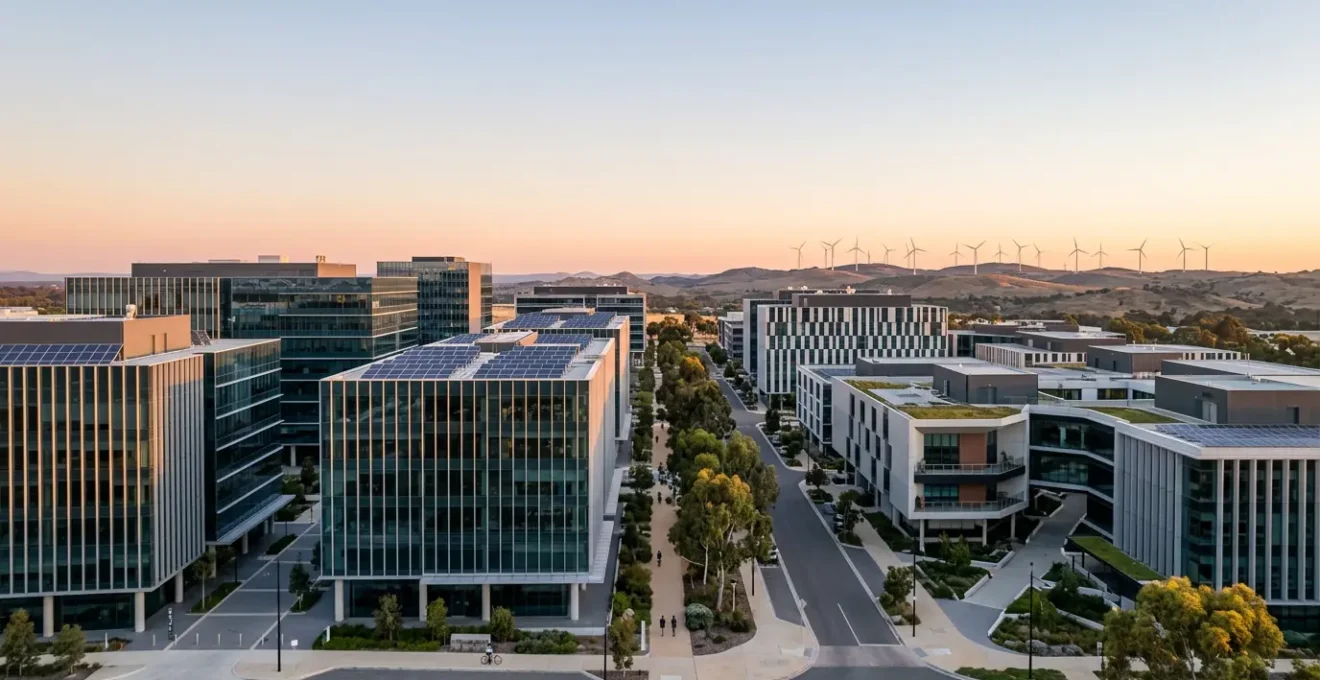
Australia’s economic stability no longer relies on resource extraction but on a strategic pivot towards services, advanced technology, and sustainable energy.
- The services sector is the new backbone, representing the vast majority of employment and GDP contribution.
- Massive investment in green energy and digital infrastructure is creating entirely new, high-skilled job categories for the coming decade.
- High-tech manufacturing and international education are building specialized value chains that prioritize intellectual property over raw materials.
Recommendation: For investors and professionals, the greatest opportunities now lie at the intersection of these growth sectors, requiring a focus on specialized, adaptable skills.
For decades, the global perception of the Australian economy has been inextricably linked to its vast mineral wealth—a nation riding the waves of commodity booms. This image, while historically accurate, is becoming increasingly outdated. The volatility of resource markets has highlighted the urgent need for a more diversified and resilient economic foundation. For investors and professionals seeking long-term stability, looking beyond the mine is no longer an option, but a necessity.
Many analyses stop at simply stating that Australia is shifting towards a service-based economy. But this observation barely scratches the surface. The real story lies in understanding the complex mechanics behind this transition. The key is not just to identify *which* sectors are growing, but to understand *how* they are creating value, *where* the new opportunities are geographically concentrating, and *why* this shift represents a fundamental rewiring of the nation’s industrial landscape. This is a move from an economy of extraction to an economy of application, intellect, and innovation.
This analysis will dissect the primary engines of Australia’s new economy. We will move beyond the headlines to explore the structural forces driving the services boom, the strategic importance of international education, the role of infrastructure as a catalyst for growth, and the rise of niche, high-tech industries. By examining these interconnected trends, we will build a clear map of the opportunities emerging in a post-mining Australia.
This article provides a detailed roadmap of Australia’s economic diversification. Explore the sections below to understand the key sectors shaping the nation’s future and discover where the most promising opportunities for investment and career growth are located.
Summary: Decoding Australia’s Economic Shift Beyond Resources
- Why 70% of Australian Jobs Are Now in Services?
- Why International Education Is Australia’s Third Largest Export?
- Infrastructure Pipeline: Where Will the Big Projects Be in 2025?
- E-commerce vs Brick-and-Mortar: Who Is Winning the Australian Shopper?
- How Australia Is carving a Niche in High-Tech Manufacturing?
- How the Green Energy Superpower Ambition Is Creating New Job Categories?
- Cremorne vs Surry Hills: Which Tech Hub Fits Your Company Culture?
- How to Pivot Your Career in a Market That Values Specialization?
Why 70% of Australian Jobs Are Now in Services?
The most profound transformation in Australia’s modern economy is the decisive shift towards services. This is not a recent trend but the culmination of decades of structural change, moving the country’s economic center of gravity away from primary industries. The sheer scale of this dominance is clear: recent data confirms that nearly 78.8% of the Australian labor force is employed in the services sector. This figure underscores a fundamental reality: Australia’s economic health and employment landscape are now overwhelmingly dictated by service-based industries.
This transition is driven by several key factors. Domestically, rising wealth and a sophisticated consumer base have fueled demand for high-value services in areas like finance, healthcare, and professional consulting. Globally, Australia has successfully positioned itself as a stable and skilled provider of services to the rapidly growing Asia-Pacific region. Sectors like financial services and legal consulting have become significant exports in their own right, leveraging the country’s strong regulatory environment and highly educated workforce.
For an investor or job seeker, this means the most stable and expansive opportunities are no longer in the resources sector but are embedded within the services ecosystem. The growth is concentrated in knowledge-intensive fields that demand specialized skills, such as data analytics, digital marketing, and aged care management. Understanding this structural dominance is the first step to identifying where future growth and career stability will originate.
Why International Education Is Australia’s Third Largest Export?
International education has evolved far beyond a simple revenue stream to become one of Australia’s most strategic economic assets. Its status as a top export is not merely about tuition fees; it’s about its role as a powerful engine for talent attraction, innovation, and “soft power” projection across the globe. The country’s world-class universities and vocational training institutions act as a magnet for ambitious students, particularly from Asia, who seek a high-quality, English-language education in a safe and desirable location.
The true economic value, however, lies in the concept of talent arbitrage. By attracting hundreds of thousands of international students each year, Australia creates a dynamic, globally-connected talent pool. Many of these graduates remain in the country, bringing their skills and international networks directly into the local workforce, particularly in high-demand fields like technology, engineering, and healthcare. This constant infusion of skilled labor provides a critical competitive advantage, feeding the growth of the very service and tech sectors that are diversifying the economy.
As the image above illustrates, the vibrancy of Australian campuses is a direct reflection of this global appeal. This multicultural and collaborative environment fosters innovation and prepares both domestic and international students for work in a globalized world. For investors, this sector represents not just direct investment in educational institutions, but also ancillary opportunities in student accommodation, ed-tech, and professional services catering to this large, transient population.
Infrastructure Pipeline: Where Will the Big Projects Be in 2025?
A nation’s ambition is often written in its infrastructure. In Australia, a massive wave of investment is underway, designed to modernize the country and act as a powerful catalyst for economic activity beyond the mining sector. The scale of this commitment is immense, highlighted by initiatives like the $110 billion National Infrastructure Plan rolling out over the next decade. This spending is not random; it is strategically targeted to solve long-term challenges and enable the growth of other key industries.
For those looking to the future, the key is to understand where this capital is being deployed. By 2025 and beyond, the pipeline is focused on several critical areas that directly support the new economy. These projects create thousands of jobs in construction and engineering in the short term, but their real value lies in the long-term economic capacity they unlock.
The major focus areas of this infrastructure push include:
- Digital Infrastructure: Expansion of data centers and fiber optic networks, recognized as strategic assets essential for the tech sector’s growth.
- Renewable Energy Zones (REZs): Large-scale development of wind, solar, and battery storage projects across multiple states to power the green transition.
- Hydrogen Export Hubs: Construction of facilities in strategic coastal locations to position Australia as a global leader in green hydrogen production.
- Transport Corridors: Upgrades to rail and road networks to improve supply chain efficiency, linking agricultural and resource hubs to domestic and international markets.
- Water Security: Resilience projects, including dams and desalination plants, designed to mitigate the impacts of climate change on agriculture and urban populations.
This pipeline provides a clear map for investors and job seekers. The opportunities are not just in building these projects, but in the industries that will leverage them once they are complete—from tech startups benefiting from faster internet to manufacturing firms powered by cheaper renewable energy.
E-commerce vs Brick-and-Mortar: Who Is Winning the Australian Shopper?
The retail landscape in Australia is undergoing a dynamic transformation, shaped by the country’s unique geography and evolving consumer habits. The debate is not simply a matter of e-commerce versus physical stores, but rather a story of hybridization and adaptation. E-commerce has seen explosive growth, fundamentally driven by its ability to overcome the “tyranny of distance”—the vast geographical spread that makes traditional retail challenging and expensive outside major urban centers.
Digital platforms have given consumers in regional and remote areas access to a global marketplace, a convenience that has cemented online shopping as a permanent fixture. This trend has been supercharged by the rise of homegrown fintech innovations, particularly Buy Now, Pay Later (BNPL) platforms like Afterpay, which have been seamlessly integrated into the online checkout process, lowering the barrier to purchase for millions of shoppers. The key battleground for e-commerce pure-plays is now focused on optimizing last-mile delivery solutions to meet consumer expectations for speed and reliability.
However, brick-and-mortar retail is not in terminal decline; it is in a state of reinvention. Forward-thinking retailers are fighting back by transforming their physical locations into experience-driven destinations. They are focusing on what online can’t offer: immediate product access, personalized service, and a tangible brand experience. Furthermore, they are embracing an omnichannel approach, integrating technology like click-and-collect hubs to merge the convenience of online browsing with the immediacy of in-store pickup. The winners in this new era are not one channel or the other, but the businesses that can create a seamless, integrated experience across both their digital and physical footprints.
How Australia Is carving a Niche in High-Tech Manufacturing?
For years, Australian manufacturing was seen as a sector in decline, unable to compete with low-cost overseas producers. However, a strategic shift is underway, moving away from mass production and towards a niche of high-tech, specialized manufacturing. This new approach leverages Australia’s core strengths: a highly skilled workforce, strong research and development institutions, and abundant natural resources. The strategy is not to compete on volume, but on value, by focusing on complex, high-margin products.
A prime example of this is the opportunity in the critical minerals value chain. The global transition to clean energy and electric vehicles is creating unprecedented demand for minerals like lithium, cobalt, and nickel, which Australia has in abundance. Historically, these materials would be mined and exported as raw ore. The new high-tech manufacturing paradigm focuses on moving up the value chain specialization ladder. This involves developing the capability to process these raw materials into higher-value products, such as battery-grade chemicals or specialized components, *before* they are exported.
The scale of this opportunity is immense. To meet global 2030 targets for the energy transition alone, it is estimated that up to 140 new copper mines, 60 new nickel mines, and 50 new lithium mines will be needed globally. By capturing the processing and manufacturing stage of this supply chain, Australia can generate significantly more economic value and create high-skilled jobs in chemical engineering, materials science, and advanced manufacturing. This niche strategy is being replicated in other areas, such as medical technology, defense hardware, and food processing technology, positioning Australia as a key player in specialized global supply chains.
How the Green Energy Superpower Ambition Is Creating New Job Categories?
Australia’s ambition to become a “green energy superpower” is more than a political slogan; it is a powerful economic strategy that is actively reshaping the nation’s job market. With abundant solar and wind resources, the country is uniquely positioned to not only decarbonize its own grid but also to become a major exporter of clean energy, primarily in the form of green hydrogen. This transition is creating a surge in demand for labor, with industry estimates showing that up to 167,900 workers could be needed in the broader renewable sector by 2050, with a significant portion dedicated to green hydrogen alone.
This economic shift is not just creating more jobs in existing roles like electricians and engineers; it is generating entirely new, specialized job categories that did not exist a decade ago. These include roles such as hydrogen plant technicians, grid integration specialists, offshore wind farm operators, and battery storage analysts. These positions require a blend of traditional trade skills and advanced technological expertise, driving demand for new vocational training and university programs.
Case Study: Murchison Green Hydrogen Project Employment Impact
The real-world impact of this ambition is visible in projects like the Murchison Green Hydrogen Project in Western Australia. Once operational, this single project is projected to create 3,600 jobs during its construction phase and 600 permanent, ongoing roles for its operation. Its goal is to produce 900,000 tonnes of green ammonia annually for export, demonstrating a tangible pathway from renewable resources to high-value, job-creating exports.
For job seekers, the green energy transition represents one of the most significant and long-lasting waves of opportunity in the coming decades. It offers a clear path for those in traditional energy sectors to retrain and for new entrants to build a career in a high-growth, future-proof industry.
Cremorne vs Surry Hills: Which Tech Hub Fits Your Company Culture?
Australia’s burgeoning technology sector is not a monolith; it is a collection of vibrant, geographically concentrated ecosystems, each with its own distinct culture, strengths, and focus. For a tech company looking to establish a presence or a professional seeking employment, choosing the right hub is a critical strategic decision. The two most prominent examples are Melbourne’s Cremorne and Sydney’s Surry Hills, which serve as excellent case studies in the different flavors of tech innovation in Australia.
The choice between these hubs often comes down to a company’s stage of development and its business model. Cremorne has earned the nickname “Scale-Up Suburb,” home to some of Australia’s most successful and established tech giants. In contrast, Surry Hills is often described as a “VC Village,” characterized by a high density of early-stage startups, creative-tech agencies, and close proximity to venture capital firms.
This table, based on a recent analysis of Australia’s economic landscape, highlights the key differences:
| Aspect | Cremorne (Melbourne) | Surry Hills (Sydney) |
|---|---|---|
| Hub Character | Scale-Up Suburb | VC Village |
| Anchor Tenants | REA Group, SEEK | Startup ecosystems |
| Business Focus | B2B, mature startups | Creative-tech, early stage |
| Key Advantage | Established tech giants | Proximity to venture capital |
An established B2B software company might thrive in Cremorne’s ecosystem of mature businesses, benefiting from the large talent pool and corporate networks. Conversely, a disruptive, consumer-facing startup seeking its first round of funding would likely find a more suitable environment in Surry Hills, with its high energy and easy access to investors. This principle of geographic concentration and cultural fit is essential for any stakeholder navigating Australia’s tech scene.
Key Takeaways
- Economic Foundation: Australia’s economy has fundamentally shifted to a service-based model, which now provides the majority of jobs and economic stability.
- Future Growth Engines: The next wave of growth will be driven by strategic investments in green energy, high-tech manufacturing, and the digital infrastructure that enables them.
- Opportunity Hotspots: The most valuable career and investment opportunities are found at the intersection of these growth sectors, in specialized niches that require targeted skills.
How to Pivot Your Career in a Market That Values Specialization?
The diversification of the Australian economy presents immense opportunities, but it also brings a new challenge: the demand for deep specialization. The broad, generalist roles of the past are giving way to positions that require specific, cross-disciplinary expertise. For professionals looking to secure their future or pivot from a declining industry, simply acquiring a new skill is not enough. The most successful career transitions involve a strategic approach to identifying and filling a niche at the intersection of two or more growth sectors.
This means thinking not just about “working in tech” or “working in green energy,” but about finding a specific, high-value role like a “Renewable Energy Financial Analyst” or a “Healthcare AI Ethicist.” These roles combine domain knowledge from one industry with technical skills from another, making candidates exceptionally valuable and difficult to replace. A successful pivot requires a methodical plan to identify these intersections, acquire the necessary credentials, and network effectively within that niche.
This process can be broken down into a clear, repeatable strategy for anyone looking to align their career with Australia’s new economic realities.
Your Action Plan: Career Pivoting in a Specialized Market
- Identify a Job-Rich Intersection: Research growth sectors (e.g., Green Energy, Tech, Healthcare, Finance) and identify a hybrid niche. Look for roles that combine two fields, such as “Agri-Tech Data Scientist” or “Digital Infrastructure Project Manager.”
- Target In-Demand Skills: Use tools like LinkedIn and industry reports to analyze job descriptions within your chosen niche. Identify the top 3 recurring skills or certifications and make them your learning priority. Focus on acquiring tangible micro-credentials or technical certificates.
- Network for Insights, Not Jobs: Connect with professionals already working in your target niche. Instead of asking directly for a job, ask for their advice on the most critical skills to acquire or the best way to gain relevant experience. This approach builds relationships and provides an insider’s view of the market.
By following this targeted approach, you can move beyond simply changing jobs and instead execute a strategic career pivot that positions you for long-term success in Australia’s evolving and increasingly specialized economy.
To capitalize on these economic trends, the next logical step is to audit your own skills or investment portfolio against the needs of these emerging sectors and create a targeted plan for upskilling or strategic allocation.