In summary:
- Stop reacting to weather; start engineering a resilient event from the ground up by defining clear decision thresholds.
- Select venues not just for their beauty, but for their built-in weather contingency options, like retractable roofs and indoor-outdoor flow.
- Master the logistics of heat, from food safety protocols to leveraging technology like smart misting systems.
- Develop a tiered contingency model with backup venues and pre-arranged transport, especially for high-stakes hospitality at major events.
- Use a well-managed weather challenge as an opportunity to build trust and “mateship” with clients and teams.
Planning a corporate event outdoors is an exercise in optimism. You envision blue skies, a gentle breeze, and guests mingling in the perfect sun-drenched setting. But as any seasoned event producer knows, hope is not a strategy. The default advice is always to “have a backup plan,” a vague platitude that often translates to a hastily booked, uninspiring indoor room that feels like a consolation prize. This approach treats bad weather as an unfortunate accident rather than an operational inevitability.
The real challenge isn’t just about having a Plan B; it’s about the agonizing decision of when to pull the trigger. Too early, and you sacrifice a beautiful day. Too late, and you’re managing a logistical disaster in a downpour, compromising guest safety and brand reputation. This reactive mindset is the single biggest point of failure for outdoor events. It focuses on disaster recovery instead of proactive design.
But what if the entire framework was flipped? What if, instead of just planning for failure, you could engineer for resilience? This guide moves beyond the simple backup plan. It provides a producer’s framework for building a weather-resilient event from its very DNA. We will explore how to establish data-driven decision triggers, select venues with contingency in mind, and manage the micro-logistics of heat and safety. It’s about transforming weather from a potential catastrophe into a manageable variable, and in some cases, an opportunity to showcase competence and build deeper relationships.
To navigate these complexities, this guide is structured to walk you through the critical decisions and strategic frameworks an event producer uses. The following sections provide a roadmap for building a truly weather-proof outdoor event.
Table of Contents: A Framework for Weather-Resilient Event Production
- Plan B: When Must You Call It and Move Indoors?
- Sydney or Melbourne: Which City Has the Best Rooftop Venue Culture?
- Hunter Valley vs Yarra Valley: Which Wine Region Is Best for Corporate Retreats?
- How to Secure Council Permits for Public Park Events?
- How to Keep Food Fresh and Drinks Cold in 35-Degree Heat?
- How to Leverage the Australian Open and Grand Prix for Corporate Hospitality?
- Café or Boardroom: Where Should You Host Your First Client Interaction?
- How to Build “Mateship” to Accelerate Trust in Business Relationships?
Plan B: When Must You Call It and Move Indoors?
The most stressful decision in outdoor event management isn’t creating Plan B; it’s knowing the precise moment to activate it. A gut feeling is not enough when significant financial and reputational capital is on the line. The solution is to remove emotion and subjectivity from the equation by establishing a formal decision matrix with pre-defined decision thresholds. This framework turns the “go/no-go” call from a panicked guess into a calculated operational response.
This process begins 72 hours out, using professional weather services, not just consumer apps. You must define specific, non-negotiable triggers. For example, a sustained wind speed over 40 km/h might endanger temporary structures, lightning within a 15-kilometre radius poses a non-negotiable safety risk, or a “feels like” temperature exceeding 40°C could make the event unsafe for guests and staff. Each trigger should be linked to a specific action in your contingency plan.
A single person must be given ultimate decision-making authority. A “decision by committee” approach leads to paralysis. This designated leader will follow a timeline of checkpoints (e.g., 48hr, 24hr, 12hr, and 4hr) to assess the data against the thresholds. At each checkpoint, the financial impact of canceling or moving—including vendor penalties and sunk costs—should be documented. This creates a clear, defensible record of why a decision was made. When a threshold is breached, a pre-scripted contingency cascade of communications is executed, informing stakeholders, vendors, and guests swiftly and clearly.
Sydney or Melbourne: Which City Has the Best Rooftop Venue Culture?
Choosing between Sydney and Melbourne for a rooftop event goes far beyond the cliché of Sydney’s sun versus Melbourne’s four-seasons-in-a-day. A producer’s analysis focuses on “climate-aware design” and the density of venues built for weather resilience. While Sydney offers more statistically reliable sunshine, Melbourne’s famously fickle weather has forced its hospitality industry to innovate, leading to a high concentration of venues with sophisticated, integrated weather-proofing.
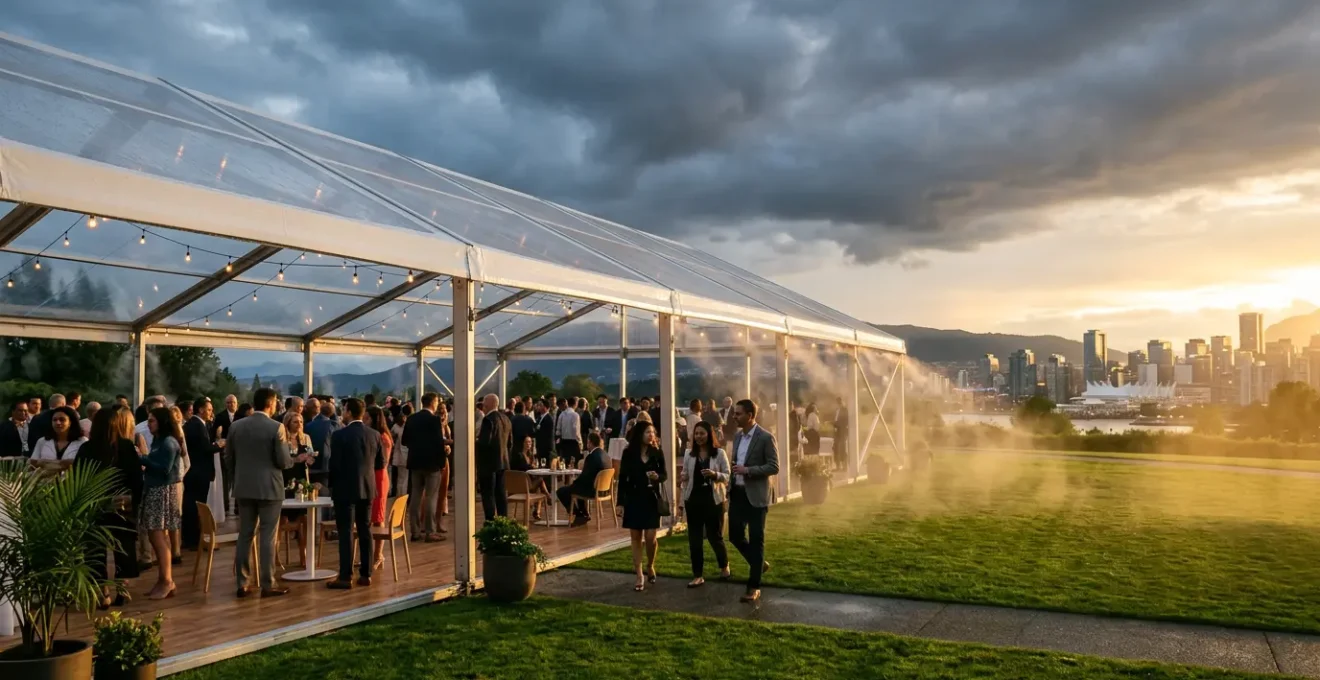
To make a strategic choice, you must evaluate cities based on a weighted framework that prioritizes reliability over simple aesthetics. This is about engineering the guest experience against potential failure points. Melbourne often scores higher on weather-protected venue density, with a wealth of laneway bars and rooftop spaces featuring retractable glass roofs, powerful heating systems, and seamless indoor/outdoor flow. Sydney’s spectacular harbour views are its main draw, but a higher proportion of its venues are fully exposed, making a weather call more binary and high-stakes. The illustration below captures the ideal: a venue that is as stunning when protected as it is when open.
As the image demonstrates, modern venues integrate weather protection as a core architectural feature, not an afterthought. A strategic evaluation of a city’s suitability for an outdoor event must look beyond a simple weather forecast, as detailed in an insightful analysis of event trends. The following framework helps quantify this decision.
| Evaluation Criteria | Weight | Key Indicators |
|---|---|---|
| Micro-climate Reliability | 35% | Average rainfall days, wind patterns, temperature consistency |
| Weather-Protected Venue Density | 30% | Venues with retractable roofs, indoor/outdoor flow options |
| Permit Friendliness | 20% | Processing time, restrictions, flexibility for weather changes |
| Infrastructure Support | 15% | Equipment availability, emergency services, transport access |
Ultimately, for an event where the view is everything and the budget allows for a high-risk/high-reward approach, Sydney is compelling. But for a producer focused on guaranteeing a seamless guest experience regardless of the forecast, Melbourne’s culture of architecturally integrated contingency often makes it the more resilient and professional choice.
Hunter Valley vs Yarra Valley: Which Wine Region Is Best for Corporate Retreats?
When planning a corporate retreat in an Australian wine region, the choice between the Hunter Valley and the Yarra Valley involves more than wine tasting notes and travel time from the nearest CBD. From a contingency perspective, you are assessing two vastly different climate risk profiles. The Hunter Valley, north of Sydney, is prone to intense summer heat and significant bushfire risk. The Yarra Valley, near Melbourne, faces challenges from flash flooding and unpredictable cool-weather systems. Your choice must be informed by a deep-level regional risk assessment.
This assessment goes beyond a seasonal forecast. It requires evaluating historical burn patterns and seasonal fire danger ratings for the Hunter, and mapping flood zones and access road reliability for the Yarra. In either region, power grid stability and mobile communication dead zones are critical factors. An event can be ruined just as easily by a power outage or inability to communicate as by rain. This planning is becoming more critical, as data shows average overnight low temperatures in June have risen 1.3°F per decade between 1949-2024, meaning even evenings provide less relief during heatwaves.
The Yarra Valley’s proximity to Melbourne’s robust infrastructure and greater number of venues with strong indoor options often gives it an edge in logistical resilience. However, the Hunter’s larger, more distributed properties can offer greater exclusivity and control over the environment. To mitigate risks in the Hunter, prioritize venues with clear, defensible spaces, on-site generators, and multiple access routes. In the Yarra, focus on venues with high elevation and proven drainage, and always have a contingency plan for road closures. The best choice depends entirely on your client’s risk tolerance and the specific time of year.
How to Secure Council Permits for Public Park Events?
Hosting an event in a public park introduces a major stakeholder: the local council. Securing permits is not a simple box-ticking exercise; it’s a negotiation that requires you to demonstrate you are a competent, low-risk partner. Your application must go beyond the basics and include a comprehensive weather contingency plan. Councils are increasingly risk-averse, and showing them you have robust protocols for wind, rain, and heat is non-negotiable.
A successful permit application is a portfolio, not a single form. It should include certifications for any temporary structures, a detailed waste management plan, noise ordinance compliance, and proof of public liability insurance that specifically covers weather-related incidents. Proactively including ground protection plans for wet weather and heat safety protocols (like access to shade and water) demonstrates professionalism and foresight. This level of detail is about building trust with the authorities. Collaboration is key; as seen in a recent Oklahoma City exercise, bringing together health departments, emergency services, and weather experts for a planning session can lead to much more robust safety protocols.
Your goal is to make it easy for the council to say “yes.” By anticipating their concerns and providing solutions within your application, you position yourself as an expert producer. This is not just red tape; it’s a critical part of your event’s risk management strategy.
Your 5-Step Weather Contingency Permit Audit
- Points of Contact: List every council department and emergency service (police, fire, ambulance) involved and confirm their event-day contact procedures.
- Contingency Documentation: Inventory all submitted documents (engineering certs, insurance, safety plans) and ensure they explicitly reference your weather triggers and evacuation plans.
- Site Plan Coherence: Confront your site plan with your weather plan. Are emergency exits clear? Is the medical tent accessible in a storm? Are ground protection mats specified for high-traffic wet areas?
- Communication Protocol: Review your communication cascade plan. How and when will you inform council liaisons and on-site park rangers if you activate your contingency plan?
- Regulatory Integration: Identify any gaps between your plan and council regulations (e.g., your planned decibel levels vs. their noise ordinance). Address these proactively with a proposed solution.
How to Keep Food Fresh and Drinks Cold in 35-Degree Heat?
In the heat of an Australian summer, food and beverage service becomes a high-stakes exercise in food safety and guest experience. The standard “Time-Temperature Danger Zone” (5°C to 60°C) accelerates dramatically at 35°C+. Perishable items like seafood or dairy can become unsafe in as little as 30 minutes. Your entire service model must be re-engineered around heat-resilient logistics.
This means abandoning large, static buffets. Instead, adopt a “small batch, high frequency” service model where food is brought from refrigerated holding areas to serving stations in small quantities and replenished constantly. All cold holding equipment must be actively managed. Iced displays need drainage to prevent food from sitting in water, and insulated containers are essential. For drinks, it’s not just about quantity; it’s about access. A best-practice example comes from the Rio de Janeiro Heat Protocol, which now mandates free water distribution at major events after a 2023 tragedy highlighted the critical need. Setting up multiple, clearly-marked hydration stations is a non-negotiable aspect of your duty of care.
Consider the menu itself as part of your strategy. Opt for dishes that hold well, such as grilled items served hot or robust salads, and avoid delicate items like mayonnaise-based salads or unpasteurized cheeses. A comprehensive guide to managing catering in all weather conditions provides critical time limits, which are essential for any event planner to know.
| Food Category | Maximum Time in Danger Zone (5-60°C) | Risk Level | Recommended Service Method |
|---|---|---|---|
| Seafood/Sushi | 30 minutes | Critical | Ice beds with drainage, small batch service |
| Dairy Products | 1 hour | High | Refrigerated stations, insulated containers |
| Cooked Meats (Cold) | 2 hours | High | Cold holding below 5°C, insulated containers |
| Cut Fruits | 2 hours | Medium | Iced displays with covers |
| Bread/Pastries | 4 hours | Low | Covered displays, shade positioning |
Ultimately, your food service plan in extreme heat is as much a health and safety document as it is a hospitality plan. Treating it with this level of seriousness is essential for a successful and safe event.
How to Leverage the Australian Open and Grand Prix for Corporate Hospitality?
Hosting a corporate hospitality event alongside a mega-event like the Australian Open or the Formula 1 Grand Prix is a power play. But it’s also a high-risk environment. The client is investing in proximity to the main event’s energy, and a weather-forced retreat to a distant, generic hotel ballroom is a total failure. The market for these premium experiences is fiercely competitive; as only 12.5% of event promoters in 2024 see ‘plenty of room for new events’, a flawless, weather-proof execution becomes a powerful differentiator.
Success requires a Radius-Based Contingency Model. This is a tiered system of venues secured in advance, based on their proximity to the main attraction.
- Plan A (The Hero): The primary outdoor or terrace venue, ideally within sight and sound of the main event (a 0-2 minute walk).
- Plan B (The Protector): A premium indoor venue with a strong atmosphere, located within a 5-minute walking radius. This allows for a quick, low-friction transition that keeps the group’s energy intact.
- Plan C (The Sanctuary): A top-tier restaurant or private space within a 10-minute chauffeured car ride, for a worst-case scenario where the entire precinct is affected.
Pre-arranged transport between all three venues is essential. The creative theme and entertainment should be modular and weather-independent, designed to work seamlessly in any of the three locations. This model ensures that no matter what the weather does, the client receives a premium, curated experience, not a compromised backup. It’s an investment in continuity and a guarantee against disappointment.
Key takeaways
- Shift from Planning to Engineering: Stop treating weather as bad luck. Build a resilient event by defining data-driven decision triggers and contingency cascades from day one.
- Venue Selection is Risk Management: Prioritize venues with built-in weather solutions like retractable roofs and seamless indoor-outdoor flow, especially in unpredictable climates like Melbourne’s.
- Master Extreme Heat Logistics: Re-engineer food service around small-batch models and active cooling. Your menu and hydration strategy are crucial components of your duty of care.
Café or Boardroom: Where Should You Host Your First Client Interaction?
While this guide focuses on large-scale events, the principle of “weather resilience engineering” scales down to even the most intimate of business meetings. The choice of where to host a first client interaction—a seemingly simple decision between a café with a terrace or a corporate boardroom—is your first opportunity to demonstrate control over the environment and, by extension, your professionalism.
A boardroom offers a sterile, predictable environment. It’s safe, but it can also be uninspiring and rigid. It communicates formality and control. A café with an outdoor space, on the other hand, offers a more relaxed, creative, and memorable atmosphere. However, it introduces variables: background noise, service interruptions, and, of course, the weather. A sudden gust of wind blowing papers away or a downpour forcing a clumsy retreat indoors can undermine the rapport you’re trying to build.
Choosing the café is not a risk if you apply the same producer mindset. It involves pre-vetting: does the café have a quiet indoor section you can move to seamlessly? Is the service sharp enough to be unobtrusive? By selecting a venue with an inherent, elegant “Plan B,” you are subtly communicating that you are a person who thinks ahead and manages variables without fuss. You get the benefit of the relaxed atmosphere with the security of a controlled environment. This micro-decision sets the tone, showing a potential client that you are capable of managing complexity with grace, whether it’s a coffee meeting or a six-figure product launch.
How to Build “Mateship” to Accelerate Trust in Business Relationships?
In business, trust isn’t built when things are easy; it’s forged when challenges are overcome together. This is the essence of “mateship” in a professional context. Ironically, a perfectly executed contingency plan during a weather event can build more profound and lasting trust with a client than a flawless, sunny day ever could. It’s a real-time, high-stakes demonstration of competence, care, and grace under pressure.
When the sky opens up and you seamlessly transition your guests to a stunning indoor space with drinks waiting, you are not just saving an event; you are delivering a powerful brand message. You are showing your client that you don’t panic, that you anticipated this very scenario, and that their guests’ comfort and safety are your primary concern. This shared experience—moving from a moment of potential chaos to one of expertly managed comfort—creates a powerful, memorable story. The client doesn’t just see a good event; they experience your problem-solving ability firsthand.
This is the ultimate ROI of weather resilience engineering. It transforms a liability into an asset. Instead of fearing the weather, a world-class producer sees it as another tool in their kit. A tool to prove their value, to protect their client’s investment, and to turn a potential disaster into a defining moment of trust and partnership. This is how you move from being a supplier to being an indispensable partner.
Start today by integrating these resilience frameworks into your planning process. By shifting your mindset from reactive planning to proactive engineering, you can transform weather from your biggest threat into your greatest opportunity to demonstrate true expertise.