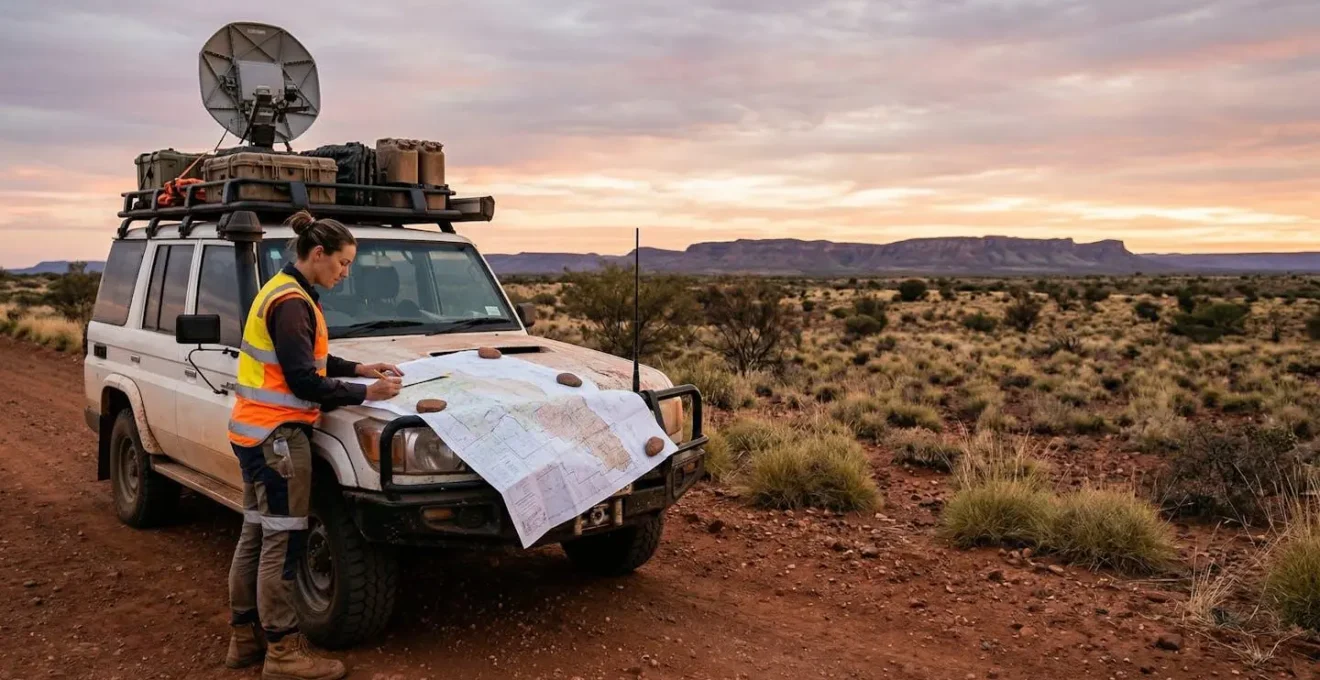
A successful remote site visit is a logistical operation, not an adventure; treating it as anything less is planning for failure.
- Operational risks like wildlife collisions and accommodation shortages are foreseeable and must be managed through strict protocols, not luck.
- Connectivity isn’t about a single device but a layered system of redundancy, from “Blue Tick” phones to satellite backups.
Recommendation: Adopt a mining-industry mindset. Treat every remote journey as a formal operation with a documented Journey Management Plan (JMP) before you even turn the key.
As a city-based auditor or engineer, your professional life revolves around precision, planning, and risk mitigation. You wouldn’t walk into a client meeting unprepared, and you meticulously plan every aspect of your project work. Yet, when that project requires a site visit to remote Australia, there’s a dangerous tendency to treat the journey itself as a simple commute. The standard advice—”check your tyres, pack extra water”—is well-meaning but dangerously insufficient. It’s the equivalent of telling an auditor to “just check the numbers.” It misses the entire operational framework that underpins professional safety in challenging environments.
The fundamental flaw in most preparation is treating the Outback as a backdrop for a road trip rather than as a complex operational theatre with foreseeable failure points. The real risks aren’t just a flat tyre; they are systemic and predictable. These include catastrophic animal strikes at predictable times, a complete lack of accommodation due to resource sector demand, and the certainty of losing all digital communication. Relying on luck is not a strategy; it’s a liability.
The key is to shift from a tourist’s mindset to an operations manager’s. This guide reframes remote travel not as an adventure in bushcraft, but as an exercise in professional risk management. It translates vague warnings into non-negotiable protocols and provides a systematic approach to guaranteeing your safety and operational effectiveness. We will deconstruct the essential components of a successful remote site visit, focusing on the standards, systems, and protocols that turn a potentially hazardous trip into a predictable, safe, and successful mission. This isn’t about being an Outback hero; it’s about being a professional who leaves nothing to chance.
This article provides a structured framework for your planning, covering everything from critical driving protocols and accommodation logistics to ensuring total connectivity and respecting local land protocols. Each section is a vital component of a comprehensive Journey Management Plan.
Summary: A Professional’s Guide to Remote Australian Site Visits
- Dawn and Dusk: Why You Should Never Drive Rural Roads at These Times?
- What to Do When Every Motel in Town Is Booked by Mining Crews?
- How to Download Maps and Docs Before You Lose Signal?
- How to Respect Indigenous Land Access Rules During Site Visits?
- Why You Must Wash Your Boots Before Entering Agricultural Sites?
- Why Is the “Blue Tick” Phone Essential for Regional Travel?
- Why Australia’s Mining Safety Standards Are the Global Benchmark?
- How to Guarantee Mobile Coverage When Traveling for Business?
Dawn and Dusk: Why You Should Never Drive Rural Roads at These Times?
In the city, dawn and dusk are just times of day. In remote Australia, they are non-negotiable no-drive windows. This isn’t a friendly suggestion; it’s a core principle of operational safety. The risk of collision with wildlife, particularly kangaroos, wallabies, and emus, skyrockets during these twilight hours. These animals are most active at dawn and dusk, and their movements are erratic. Combined with low sun angles and deep shadows that destroy driver visibility, it creates a scenario where a serious incident is not a matter of ‘if’ but ‘when’.
The consequences are not trivial. An impact with a large kangaroo can easily disable a standard vehicle, leaving you stranded hundreds of kilometres from assistance. The physical danger is also severe; Victoria Police data reveals that 921 injury collisions and 20 fatalities occurred in just five years from animal-related strikes. From a business perspective, the financial costs are also significant. An analysis of thousands of insurance claims found that nearly one in five vehicles involved in wildlife strikes were total write-offs, with the average repair bill for surviving vehicles reaching thousands of dollars. These are foreseeable and unacceptable risks in a professional context.
Therefore, the only professional approach is to implement a strict “Sunset Rule”: all driving must cease at least 90 minutes before the official sunset time. Your Journey Management Plan (JMP) must be built around this constraint, working backwards from your destination’s sunset time to determine a non-negotiable departure time. This isn’t being overly cautious; it’s demonstrating the operational integrity of a professional who manages known risks rather than gambling with them.
Your Action Plan: The Sunset Rule Protocol
- Check the official sunset time for your destination using the Bureau of Meteorology website for the specific date of travel.
- Calculate your mandatory “hard stop” arrival time, which must be a minimum of 90 minutes before the documented sunset.
- Plan your journey duration, then add a 20% time buffer for unexpected delays. Work backwards from your hard stop time to set your latest possible departure.
- Formally document this timing calculation within your Journey Management Plan (JMP) and share it with your designated contact person.
- Set multiple phone alarms: one for your departure time, a halfway point check-in, and a final “tools down, find accommodation” alert one hour before your hard stop time.
What to Do When Every Motel in Town Is Booked by Mining Crews?
A common mistake for city-based travellers is assuming accommodation is readily available. In many remote Australian towns, the entire housing and motel stock is permanently block-booked by mining, resource, and construction companies for their fly-in, fly-out (FIFO) workforce. This isn’t a seasonal peak; it’s a permanent state of zero vacancy. In fact, the housing shortage is so acute that some mining companies report having over 100 skilled jobs unfilled for years simply because there is nowhere for workers to live.
Arriving in a town at dusk with no booking is not an inconvenience; it’s a critical failure in planning that can leave you with the dangerous choice of sleeping in your car or driving on through the night. A professional approach requires treating accommodation as a logistical challenge to be solved weeks in advance, not upon arrival. This involves exploring alternatives beyond mainstream booking websites, which often don’t reflect the true availability on the ground. The most reliable solution, however, is to remove the dependency on local infrastructure altogether.
Adopting a mindset of professional self-sufficiency is the ultimate form of risk mitigation. This involves investing in a high-quality vehicle-based sleeping system. A top-tier swag, a vehicle-mounted awning, a portable fridge, and a water tank transform your vehicle from mere transport into a reliable accommodation platform. This one-time investment provides guaranteed lodging, removes a major point of failure from your JMP, and gives you ultimate flexibility in your travel schedule.
The table below outlines the hierarchy of accommodation strategies, from least to most reliable. While local options can work with enough lead time, only a self-sufficient setup offers true operational certainty. This is the gold standard for any professional travelling frequently to remote areas.
| Strategy | Lead Time Required | Cost Range | Reliability |
|---|---|---|---|
| Local Council Guesthouses | 1-2 weeks advance | $80-120/night | Moderate |
| Farm Stays via Local Networks | 2-3 weeks advance | $60-100/night | Variable |
| Mining Company Overflow Agreements | 4-6 weeks advance | $150-250/night | High |
| Professional Self-Sufficiency Kit | One-time setup | $2000-4000 initial | Guaranteed |
How to Download Maps and Docs Before You Lose Signal?
One of the most critical foreseeable failure points in any remote site visit is the loss of mobile data. It is not a possibility; it is a certainty. Relying on live access to cloud-based maps, site plans, audit documents, or company intranets is a recipe for operational paralysis. Once you are 50 kilometres outside a major regional town, you must assume your data connection will cease to exist. Planning for this eventuality is a non-negotiable part of your pre-trip preparation.
The primary action is to download all necessary geographic information for offline use. Both Google Maps and Apple Maps have robust features for this. For Google Maps, search for your destination area, tap the location’s name at the bottom, and select the “Download” option. Be generous with the map area you select, capturing your entire route and a wide buffer zone around your destination. This saves not just the road layout but also key points of interest and basic topographical data directly to your device.
The same principle of pre-emptive data caching applies to all work-related documents. Your company’s document management system (like SharePoint, Google Drive, or Dropbox) allows you to mark specific files and folders as “Available Offline.” This must be done while you have a stable Wi-Fi connection days before your departure. Create a dedicated “SITE VISIT” folder containing every possible document you might need: site-access permits, audit checklists, technical schematics, contact lists, and safety procedures. Synchronise this entire folder for offline access on both your laptop and your tablet. This simple protocol ensures that a lack of signal never becomes a barrier to your professional duties.
How to Respect Indigenous Land Access Rules During Site Visits?
Navigating remote Australia requires more than just a map; it demands an understanding of and deep respect for the complex tapestry of land ownership, particularly Indigenous land rights. Assuming that a road on a map grants you automatic access is a profound and unprofessional error. Many pastoral leases, national parks, and even seemingly public roads transect areas where Native Title has been determined, granting traditional owners specific rights and interests in the land.
Respectful and lawful access is a cornerstone of professional conduct. The first step in your planning process should be to consult the National Native Title Tribunal (NNTT) maps to understand if your intended route or site destination falls within a determined Native Title area. This is not just a courtesy; it can be a matter of legal compliance. Ignoring these protocols can jeopardise your company’s relationship with local communities and potentially breach land use agreements.
Once you have identified the relevant Traditional Owner groups, the next step is to make contact. The designated body is usually a local Aboriginal Land Council or a Prescribed Body Corporate (PBC). Reach out well in advance of your trip. Explain who you are, the purpose of your visit, and your intended route. Do not ask for “permission” in a tokenistic way; engage in a genuine dialogue to understand any specific protocols, sensitive sites to avoid, or preferred routes. This act of proactive engagement demonstrates respect and is a critical part of building trust and ensuring your visit proceeds smoothly and without causing unintended offence or disruption. It should be a formal, documented step in your Journey Management Plan.
Why You Must Wash Your Boots Before Entering Agricultural Sites?
To an outsider, a request to wash boots and vehicle tyres before entering a farm or vineyard might seem like a trivial piece of rural etiquette. In reality, it is a critical biosecurity protocol with significant financial and ecological implications for your client. As a visiting professional, your boots and vehicle can act as vectors, carrying microscopic pests, diseases, and weed seeds from one property to another. Adhering to these protocols is not optional; it is a fundamental demonstration of your professional responsibility.
The risks are very real. For example, the wine industry lives in constant fear of phylloxera, a microscopic insect that attacks grapevine roots, eventually killing the plant. An outbreak can devastate an entire wine region, and the pest is easily transported in soil attached to footwear or vehicles. Similarly, for graziers and grain farmers, the spread of invasive weed seeds like Parthenium or serrated tussock can ruin pastureland, costing millions in control measures and lost productivity. Your compliance is a direct contribution to protecting your client’s livelihood and assets.
Therefore, treat biosecurity with the same seriousness as safety. Your visit preparation should include a dedicated biosecurity kit containing a stiff brush, a spray bottle, and a disinfectant solution (like a 1% bleach solution). Before arriving at the site gate, thoroughly clean all soil and organic matter from your boots and spray them with the disinfectant. If you have been off-road, inspect your vehicle’s tyres and undercarriage for mud and plant material. Arriving at a site with clean boots and informing your host that you have followed biosecurity measures immediately establishes your credibility and professionalism. It shows you understand their world and respect their operational risks.
Why Is the “Blue Tick” Phone Essential for Regional Travel?
In the urban jungle, all smartphones seem equal. In the Australian bush, they are not. When your personal safety and professional effectiveness depend on a signal, the single most important feature to look for in a mobile handset is the “Blue Tick.” This is not a marketing gimmick; it’s a certification awarded by Telstra, Australia’s largest network provider, to devices that offer superior coverage performance in regional and rural areas.
The Blue Tick certification is based on rigorous testing of a phone’s hardware, specifically its antenna design and its ability to pick up and hold onto a weak signal at the edge of a coverage cell. Phones that earn the tick are demonstrably better at receiving signals in challenging terrain than their non-certified counterparts. For a professional travelling remotely, this can be the difference between making a critical call and seeing “No Service” on your screen. A standard city phone, even on the same network, will lose signal far sooner than a Blue Tick-rated device.
Furthermore, every Blue Tick phone features an external antenna port. This is a crucial element of a layered communication strategy. It allows you to connect the handset to a vehicle-mounted antenna, which dramatically boosts its signal reception capabilities. This turns your vehicle into a powerful mobile communication hub. Choosing a Blue Tick phone shouldn’t be an afterthought; it should be the foundational element of your personal communication system. It is the primary tool in your connectivity arsenal and the professional standard for anyone whose work takes them beyond city limits.
Key takeaways
- Treat every remote trip as a formal operation with a documented Journey Management Plan (JMP), not a casual drive.
- Implement a strict “Sunset Rule” by planning your journey to be off the road 90 minutes before sunset to mitigate wildlife collision risk.
- Build a redundant, multi-layered communication system; never rely on a single device for connectivity.
Why Australia’s Mining Safety Standards Are the Global Benchmark?
When seeking a model for professional conduct in remote operations, look no further than Australia’s mining and resources sector. Its safety standards are recognised as the global benchmark, not because of a single rule, but because of a deeply ingrained culture of systematic risk management. For any professional venturing into the Outback, adopting the core principles of this safety culture is the fastest way to elevate your personal and operational security.
The cornerstone of this system is the Journey Management Plan (JMP). No employee in the resources sector undertakes a remote journey without one. A JMP is a formal document that details the route, driver, vehicle, travel times, communication schedules, and emergency contingencies. It is lodged with a supervisor before departure and requires regular check-ins at predetermined points. If a check-in is missed, an emergency procedure is triggered immediately. This simple, formalised process transforms “telling someone your plan” from a casual chat into a robust, auditable safety system.
This culture is further supported by a legal framework of “chain of responsibility” and a universal commitment to hazard identification and risk assessment. Every task, including driving from Point A to Point B, is broken down, its risks are identified (e.g., driver fatigue, wildlife, vehicle failure), and control measures are put in place to mitigate them. This proactive, non-complacent mindset is what separates professionals from amateurs. Emulating this approach—by formally documenting your own JMP for every trip—is the single most effective step you can take to align your personal safety with the world’s best practice.
How to Guarantee Mobile Coverage When Traveling for Business?
In a remote operational context, “guaranteeing” coverage is not about finding a single magic device. It’s about building a robust, multi-layered system of redundancy. Relying on one method of communication is a critical point of failure. A professional approach mirrors the engineering principle of having primary, secondary, and tertiary systems to ensure operational continuity. This ensures you can always communicate, whether for a routine check-in or a critical emergency.
Tier 1: The Primary System. This is your day-to-day workhorse: a “Blue Tick” certified smartphone operating on the Telstra network. As discussed, its superior antenna design provides the best possible performance within the bounds of the cellular network. This is your baseline, the non-negotiable starting point for professional remote communication.
Tier 2: The Secondary System. This layer enhances your primary system. It consists of a high-gain, vehicle-mounted external antenna connected directly to your Blue Tick phone. This setup can capture a usable signal where the phone alone would fail, effectively extending the network’s reach by many kilometres. It turns your vehicle into a significantly more powerful communication node, ideal for use on the fringes of service areas.
Tier 3: The Emergency Fail-Safe. This system operates completely independently of the cellular network. It is your ultimate guarantee of contact in a crisis. You have two main options: a satellite phone or a Personal Locator Beacon (PLB). A satellite phone allows for two-way voice and data communication from anywhere on the continent, but requires a subscription. A PLB is a one-way distress device that, when activated, transmits a powerful emergency signal to rescue authorities via satellite. For any professional travelling solo or to extremely remote locations, carrying a PLB is an essential and life-saving piece of equipment.
Now that you have the framework for safety, accommodation, and communication, the next step is to formalise it. Start building your own detailed Journey Management Plan for your next remote site visit, because professional preparation is the only true guarantee of a successful and safe return.