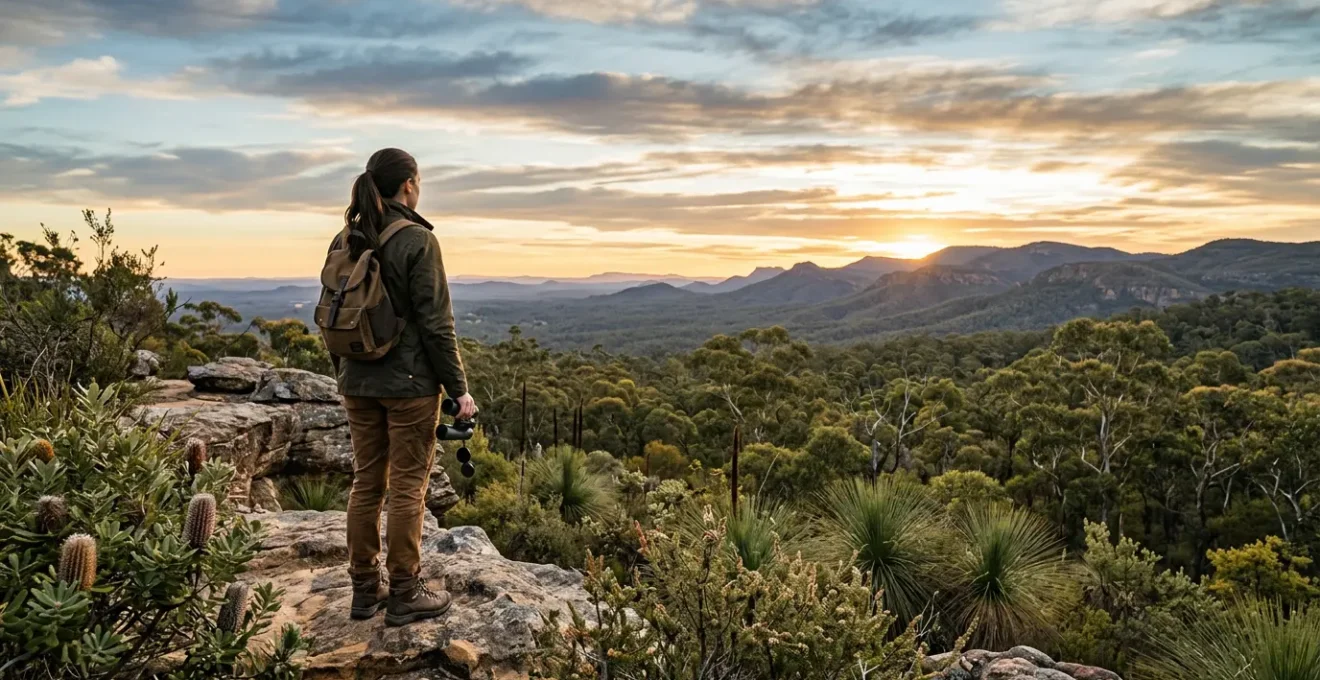
Contrary to the common narrative of fear, truly experiencing Australia’s wilderness isn’t about simply avoiding danger or following rules. As a ranger, I’ve seen that the most profound journeys come from shifting your mindset from a consumer of experiences to a temporary custodian of the land. This guide moves beyond basic tips to show you how to actively participate in conservation and engage with the environment’s deep cultural fabric, ensuring your adventure is not only safe but also meaningful and respectful.
The call of the Australian wilderness is powerful. It’s a landscape of ancient rock, sprawling bushland, and unique creatures that promises adventure. Yet, for many, this promise is tinged with a hint of apprehension. You’ve heard the stories: the venomous snakes, the formidable spiders, the vast, unforgiving distances. The standard advice—pack enough water, wear sturdy boots, watch where you step—is a start, but it barely scratches the surface of what it means to travel here with awareness and respect.
Many guides will give you a list of things to fear and rules to follow. But what if the key to a safe and transformative experience wasn’t just about avoiding negative encounters, but about fostering positive connections? What if, instead of simply being a visitor passing through, you could become a temporary custodian, leaving the land and its stories richer for your presence? This is the perspective of a park ranger, and it’s the journey I want to guide you on. It’s about understanding the ‘why’ behind the rules and seeing the landscape not just as a place, but as a living system with a deep history.
This guide is structured to build that understanding. We will start by reframing your relationship with wildlife, then move to balancing comfort with conservation, and cover the essential gear that protects you. Most importantly, we will delve into how to respectfully engage with the world’s oldest living culture, which is inextricably woven into the land itself. By the end, you’ll have the tools to explore with confidence, safety, and a profound sense of connection.
Summary: A Ranger’s Guide to Responsible Exploration in Australia
- Snakes and Spiders: What to Do If You Encounter One on the Trail?
- How to Sleep Under the Stars Without Giving Up Luxury?
- Water and PLB: What Is Essential Gear for a Day Hike?
- Why Seeing the Land Through an Indigenous Guide Changes Everything?
- How to Camp in National Parks Without Leaving a Footprint?
- How to Respect Indigenous Land Access Rules During Site Visits?
- How to Plan Micro-Adventures That Fit Between Friday 5 PM and Monday 9 AM?
- How to Perform an “Acknowledgement of Country” Without Being Tokenistic?
Snakes and Spiders: What to Do If You Encounter One on the Trail?
The first question I always get is about our famous creepy-crawlies. Let’s start by putting risk into perspective. Sensationalism sells, but the reality is far calmer. For instance, despite Australia being home to venomous spiders, statistics show less than one death per year from bites. Most of these creatures are shy and defensive, not aggressive. Think of them as the park’s own pest control service, a vital part of the ecological machinery. Your goal isn’t to be scared of them, but to respectfully share the trail with them.
If you encounter a snake or a large spider, the most important rule is the simplest: Stop. Do not panic. These animals react to movement and vibration. By freezing, you remove the trigger for their defensive response. Give them a wide berth, and let them move on. Never try to touch, provoke, or kill them. They are protected species and a crucial part of the ecosystem you’ve come to enjoy. Stomp your feet a little as you walk; the vibrations will often warn snakes of your approach long before you see them, allowing them to move away.
Your best protection is awareness. Wear sturdy, closed-toe boots and long pants if you’re walking through thick undergrowth. When gathering firewood or moving rocks, use a stick to poke around first and always wear gloves. At night, use a flashlight and be sure to shake out your boots and clothes in the morning before putting them on. These simple, commonsense precautions are far more effective than fear.
How to Sleep Under the Stars Without Giving Up Luxury?
The idea of “roughing it” is no longer the only way to get close to nature. In fact, some of the most conservation-minded experiences in Australia blend comfort with a deep commitment to the environment. The new standard of luxury is not about opulence, but about exclusive access, deep connection, and minimal impact. It’s about experiencing the wild without sacrificing comfort or your values.
This is where concepts like “glamping” and eco-lodges shine. These operations often use cutting-edge sustainable technologies like solar power, rainwater harvesting, and advanced waste treatment to operate off-grid. They allow you to fall asleep to the sounds of the bush in a comfortable bed and wake up to breathtaking views, all while your environmental footprint is kept to an absolute minimum. More importantly, many of these eco-tourism operators are deeply involved in local conservation.
Take, for example, the model of certain high-end wildlife tours. These aren’t just passive sightseeing trips; they are active contributions to conservation. As mentioned in a case study by Australia.com about ventures like Echidna Walkabout Nature Tours, guests might join researchers to monitor koala populations or help with habitat restoration projects. This model transforms tourism from an extractive industry into a regenerative one. You’re not just a tourist; you’re a patron of conservation, and your travel dollars directly fund the protection of the environment you’re enjoying. This is the true luxury: an experience that gives back.
Water and PLB: What Is Essential Gear for a Day Hike?
As a ranger, when I check a hiker’s pack, I’m looking for more than just snacks and a camera. Your gear is your lifeline, and two items are non-negotiable for safety in the Australian bush: sufficient water and a Personal Locator Beacon (PLB). Dehydration can set in incredibly fast here, even on overcast days. The standard rule is one litre of water per person for every two hours of hiking, but you should always carry more than you think you’ll need. Never assume you will find water on the trail; creeks and water tanks marked on maps can be dry.
A PLB is a small device that, when activated, sends a distress signal with your location to emergency services via satellite. Mobile phone coverage is unreliable or non-existent in most national parks. A PLB is your only guaranteed way to call for help if you are lost, injured, or in a life-threatening situation. You can rent them affordably from many outdoor stores and even some police stations or national park offices. Carrying one is a sign of a responsible, self-reliant hiker.
However, the most important piece of gear is not in your pack; it’s in your head. It’s your ability to stay calm and make rational decisions when things go wrong. If you do find yourself lost or in trouble, resist the urge to panic and push on. This is where a simple mental model can save your life.
Your Mental First-Aid Kit: The S.T.O.P. Model
- Stop: Sit down. Put down your pack. Resist the urge to act immediately. Take a drink of water and have a snack.
- Think: Assess your situation objectively. Where did you last know your exact location? What resources do you have (water, food, daylight)?
- Observe: Check the weather, the time, and your physical condition. Can you hear anything? See any landmarks?
- Plan: Make a rational decision based on the facts you’ve gathered, not on fear or frustration. Often, the best plan is to stay put and wait for rescue, especially if you have a PLB.
Why Seeing the Land Through an Indigenous Guide Changes Everything?
You can look at a landscape and see a collection of trees, rocks, and rivers. Or, you can see a library of stories, a map of genealogies, and a source of sustenance and spirituality that stretches back 65,000 years. The difference is perspective, and there is no better way to gain this deeper perspective than by walking on Country with an Indigenous guide from the local Traditional Owner group.
Hiring an Indigenous guide transforms a simple hike into a profound cultural education. A waterhole ceases to be just a place to fill your bottle; you learn its name, the story of its creation, and its role in trade routes. A plant is no longer just flora; it’s a pharmacy, a supermarket, or a tool. This is what’s known as “cultural cartography”—the land comes alive with meaning. As Natural Habitat Adventures explains when describing these experiences, “we witness how local people are bringing the wisdom of traditional sustainable living” to the modern world. This is not a history lesson; it is a living, breathing connection.
Choosing a genuine experience is paramount. Support is best directed towards 100% Indigenous-owned and operated businesses. Look for certifications and endorsements from local Aboriginal Land Councils. When you do this, your tourism directly supports cultural preservation, self-determination, and the economic well-being of the community. It’s a powerful act of reconciliation and reciprocity. You receive an unforgettable experience, and the community retains control over how its culture and land are shared.
How to Camp in National Parks Without Leaving a Footprint?
The “Leave No Trace” philosophy is a great starting point for any outdoor enthusiast: pack it in, pack it out. But in Australia’s unique and fragile ecosystems, we must go further. We need to think about our “invisible footprint”—the things we leave behind that we can’t see, such as microscopic seeds, fungal spores, and pathogens that can devastate native flora and fauna.
This is the principle of biosecurity, and it’s a core responsibility for every visitor. Many of our ecosystems have evolved in isolation, leaving them highly vulnerable to invasive species and diseases. A single seed trapped in the tread of your boot or a particle of dirt on your tent peg could introduce a weed that chokes out native orchids, or a fungus like Phytophthora (dieback) that kills entire forests. Before you enter a national park, and especially when moving between different parks, it’s crucial to ensure your gear is spotless.
Your biosecurity checklist should include:
- Before you leave home: Thoroughly clean and scrub your boots, brushing out the treads and disinfecting with a diluted bleach solution.
- Check your gear: Inspect your tent, backpack, clothing, and even your vehicle for any plant material, seeds, or mud.
- On arrival: Use the boot cleaning stations if they are provided at trailheads. They are there for a critical reason.
- After your trip: Wash all your gear before storing it to prevent cross-contamination on your next adventure.
This mindset extends to all your actions. Camp on durable surfaces like rock or designated tent pads. Wash dishes and yourself at least 50 metres away from any watercourse to prevent soap from harming aquatic life. By adopting this deeper level of care, you move from being a passive user to an active guardian of the park, participating in what Australia’s Strategy for Nature calls a loop of “connecting people with nature” to enhance our collective care for it.
How to Respect Indigenous Land Access Rules During Site Visits?
All of Australia is, and always will be, Aboriginal land. While many areas are managed as public national parks, this does not extinguish their profound and ongoing significance to Traditional Custodians. Respecting this fact begins before you even pack your bag. It requires proactive research to understand that access is a privilege, not a right, and that some areas may be restricted for cultural reasons.
These restrictions are not arbitrary. Some sites may be reserved for specific ceremonies, some may be gender-specific (men’s or women’s business), and others may be so spiritually significant that they are not to be visited by outsiders at all. Seasonal closures for ceremonial purposes are also common. Ignoring these protocols, even unintentionally, can cause deep offense and spiritual harm. The onus is on you, the visitor, to be informed.
Your pre-trip research should be a standard part of your planning process. Here’s a protocol to follow:
- Start with the official National Park website, which will list major known restrictions.
- For more detailed information, check the websites of the local Aboriginal Land Council or any relevant Indigenous Protected Area (IPA) authority for that region.
- Always obey all signage on the ground. A simple sign asking you not to photograph or climb a feature is a legally and culturally significant instruction.
- If in doubt, don’t go. Assume an unmarked trail is not for you. The best way to visit culturally sensitive areas is always with a licensed Indigenous guide who has permission to be there.
As seen in places like the Tiwi Islands, following these protocols leads to incredibly rewarding and authentic travel experiences, creating a relationship built on mutual respect.
How to Plan Micro-Adventures That Fit Between Friday 5 PM and Monday 9 AM?
You don’t need to take a month off to have a meaningful adventure. The “micro-adventure”—a short, local, and affordable trip packed into a weekend—is a powerful way to reconnect with nature. The key to a successful micro-adventure is efficiency and preparation, both in your gear and your mindset. It’s about minimizing friction so you can maximize your time outdoors.
The biggest hurdle is often the mental transition from the work week to the weekend. Create a “decompression protocol” for your Friday evening. This could involve changing out of your work clothes the moment you get home, putting your phone on airplane mode for the first hour, and having a dedicated “adventure playlist” for the drive to the trailhead. The goal is to arrive at your destination with your mind already in the moment, not still processing emails.
The other half of the equation is having your gear ready to go. A “Go-Bag” system, where you have pre-packed kits for different types of adventures, is a game-changer. This eliminates the time-consuming process of packing from scratch and reduces the chance you’ll forget something crucial. A thematic system allows you to simply grab the right bag, add food and water, and walk out the door.
| Bag Type | Core Items | Ready Time | Best For |
|---|---|---|---|
| Coastal Day Hike | Sun protection, tide charts, first aid, 3L water | Grab & go | Beach walks, cliff paths |
| Overnight Bush Camp | Ultralight tent, sleeping system, cook kit, PLB | 5 min add food | Friday night escapes |
| River & Gorge Explorer | Dry bags, water shoes, rope, extra first aid | Grab & go | Canyon scrambles |
Key takeaways
- True responsible exploration is a mindset shift from ‘visitor’ to ‘custodian’.
- Your safety depends more on calm awareness and preparation than on fear of wildlife.
- Engaging with Indigenous culture through guides and research transforms your experience and supports communities directly.
How to Perform an “Acknowledgement of Country” Without Being Tokenistic?
You may have heard an “Acknowledgement of Country” at the start of an event in Australia. It’s a way of showing respect to the Traditional Custodians of the land on which you stand. As a visitor, offering your own personal, sincere acknowledgement can be a profound way to begin your journey. But for it to be meaningful, it must be more than a tokenistic, recited phrase. It must come from a place of genuine reflection and research.
A tokenistic acknowledgement is generic and impersonal. A sincere one is specific, personal, and informed. It demonstrates that you have taken the time to understand where you are. This is not about a public performance; it can be a quiet moment of reflection as you arrive at a campsite or stand at a lookout. The goal is to ground yourself in the reality that you are a guest on someone else’s ancestral home.
To make your acknowledgement sincere, follow three essential pillars:
- Research: Before you go, identify the specific Traditional Custodians of the area you are visiting. Use resources like the AIATSIS map of Indigenous Australia. Acknowledging the “Gunditjmara people” is far more meaningful than referring to “Aboriginal people” in general. Practice the pronunciation of the nation’s name.
- Reflection: Take five minutes to think about what “connection to Country” means. Consider the deep, unbroken connection Traditional Custodians have had with that very spot for millennia. Reflect on your own relationship with nature and what it means to be a guest there.
- Respect: Combine your research and reflection into a personal, quiet acknowledgement. It can be as simple as thinking to yourself, “I am on Gunditjmara Country. I thank them for allowing me to be here and I pay my respects to their Elders, past and present.”
Now that you have the tools for a deeper, more respectful journey, your next step is to plan your first intentional adventure. Start by incorporating one of these principles—perhaps researching the Traditional Custodians of your local park—and see how it transforms your connection to the land.