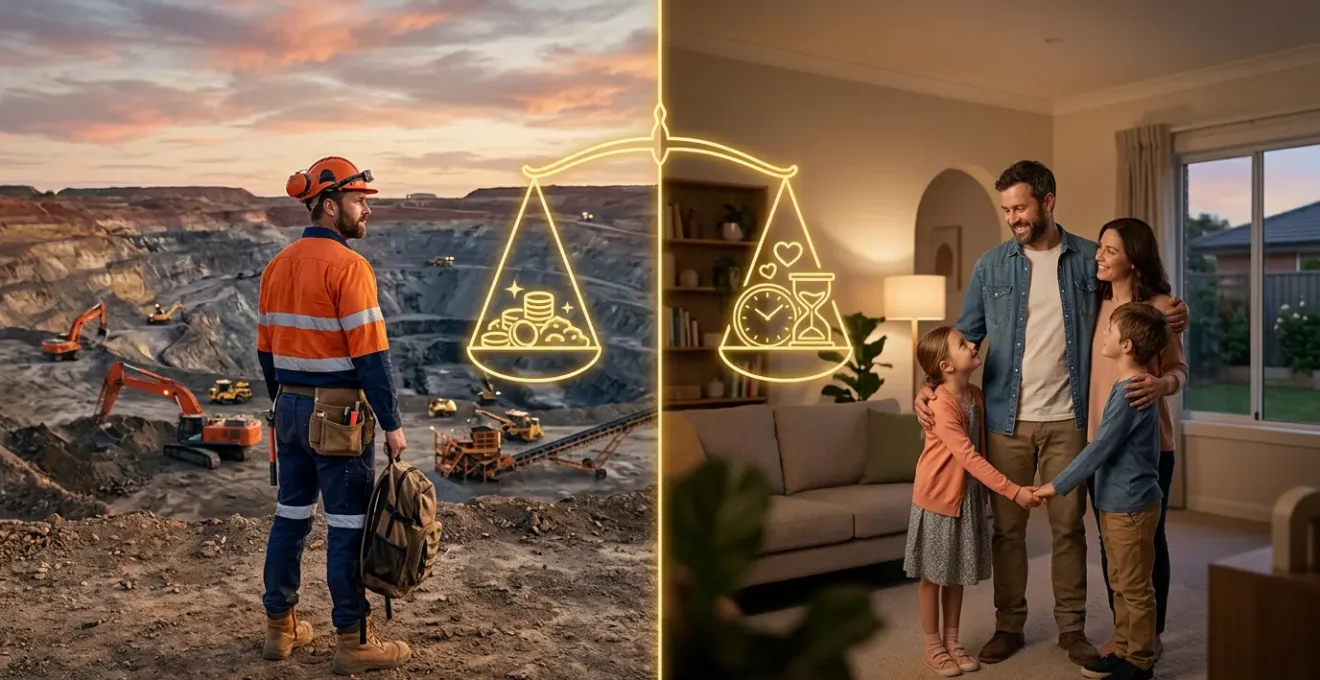
The FIFO vs. residential debate is not a lifestyle choice; it’s a financial calculation. The right answer depends on which model offers you the highest ‘wealth velocity’ after accounting for all costs, including the financial impact of lifestyle and mental strain.
- Fly-in fly-out (FIFO) roles often present a higher upfront salary and savings potential, but come with significant, often uncosted, psychological and relationship ‘liabilities’.
- Residential roles offer stability and community integration but can involve higher living costs and potentially slower career progression in certain boom-and-bust cycles.
Recommendation: Treat your career choice like a portfolio. Analyze each option based on its total financial impact—including savings rate, career optionality, and mental wellbeing—to build a robust strategy for long-term wealth, not just a high short-term income.
For any worker eyeing the lucrative salaries of the resources sector, the “FIFO or residential” question seems to be the first and most important decision. The common advice paints a simple picture: choose FIFO for the money and sacrifice your social life, or choose residential for the community and sacrifice your savings rate. This binary choice is presented as an unavoidable trade-off between your bank account and your happiness. But what if this is the wrong way to look at the problem entirely?
The standard conversation gets stuck on superficial pros and cons, missing the core strategic question. High-earning professionals in any other industry analyze investments, calculate ROI, and build strategies to maximize net worth. It’s time to apply that same rigorous, lucrative-focused mindset to your mining career. The real challenge isn’t choosing between two lifestyles; it’s identifying which operational model will most efficiently accelerate your journey to financial independence.
This analysis moves beyond the generic advice. We will dissect the FIFO and residential models as competing financial strategies. We will quantify the costs—both visible and hidden—and evaluate the opportunities each path presents for long-term wealth creation. By the end, you won’t just have an opinion; you’ll have a framework for making the most profitable decision of your career.
To make an informed financial decision, it’s crucial to understand all the variables at play. This article breaks down the key factors that influence your wealth-building potential in the mining industry, from personal relationships and safety standards to commodity cycles and future career pivots.
Summary: A Strategic Breakdown of FIFO vs. Residential Wealth Potential
- How to Maintain Family Relationships While Working 2 Weeks On, 1 Week Off?
- Why Australia’s Mining Safety Standards Are the Global Benchmark?
- Will Autonomous Trucks Steal Your Mining Job in the Pilbara?
- Iron Ore or Gold: Which Commodity Offer Better Job Security?
- How Mining Companies Are engaging Communities to Avoid Shut-Downs?
- How to Meet Strict ESG Standards Without Killing Profitability?
- What to Do When Every Motel in Town Is Booked by Mining Crews?
- How to Pivot from Traditional Mining to Critical Minerals for EVs?
How to Maintain Family Relationships While Working 2 Weeks On, 1 Week Off?
The most significant, and often underestimated, liability in a FIFO career is the strain it places on relationships. This isn’t just an emotional cost; it has a tangible impact on your performance, resilience, and long-term earning potential. Treating this as a soft issue is a strategic error. Instead, it must be quantified as a primary risk factor. For instance, 32.7% of FIFO partners experience high psychological distress, more than double the rate of non-FIFO partners. A distressed home environment is a direct threat to your on-site focus and career longevity.
The key is to move from passive communication to an active, structured connection strategy. This involves pre-planning communication times, investing in high-quality internet for seamless video calls, and creating shared routines even when apart, like watching a series simultaneously. It’s about mitigating the “lifestyle liability” before it compounds.
Forward-thinking initiatives recognize this link between family wellbeing and operational stability. The FIFO Family Project, for example, developed specific resources like “The FIFO New Parents Guide” to address these unique challenges. These tools provide frameworks for managing mental health and relationship dynamics, effectively serving as an insurance policy against the personal costs of FIFO work. Viewing these resources not as self-help but as essential operational tools is the first step in protecting your most valuable asset: a stable home base.
Why Australia’s Mining Safety Standards Are the Global Benchmark?
Australia’s reputation for world-class mining safety isn’t just about hard hats and steel-toed boots; it’s a comprehensive system that increasingly recognizes psychological health as a core component of operational safety. For a worker, this system is a crucial asset that protects your ability to earn. A career-ending injury, whether physical or mental, is the ultimate financial catastrophe. The country’s standards are a benchmark because they are evolving to manage the total risk profile of a modern miner.
The government of Western Australia, a global mining hub, has been a key driver in this evolution, instituting policies that extend beyond the physical mine site. These regulations and best practices are designed to manage the unique stressors and fatigue associated with remote work, particularly FIFO rosters. This proactive approach directly translates into a more stable and reliable workforce, which is a win for both the company and the employee. A safe worker is a productive worker, and a robust safety framework is what allows for sustained high performance over a long career.
The most advanced safety protocols now integrate measures against fatigue and psychological strain directly into risk management. These aren’t optional extras; they are fundamental to preventing costly errors and maintaining productivity. Key elements include:
- Strict Shift Limits: Mandatory caps on consecutive shifts, such as 8-day maximums for 12-hour days, to prevent fatigue-related accidents.
- Mental Health Integration: Establishing comprehensive mental health support services with the same priority as physical safety protocols.
- Rest and Recuperation: Ensuring sufficient rest days between rotations to recover from sleep debt and circadian rhythm disruption.
- Psychological Safety Audits: Integrating psychological safety assessments into standard risk management procedures to proactively identify and mitigate sources of stress and burnout.
Will Autonomous Trucks Steal Your Mining Job in the Pilbara?
The conversation around autonomous trucks misses the point. The threat isn’t just automation; it’s the underlying economic imperative that drives it. The same financial logic that makes a company invest in a driverless truck is what dictates its preference for FIFO over residential workers. It all comes down to the total cost of extraction. Your job isn’t threatened by a robot; it’s threatened by being on the wrong side of the balance sheet.
The numbers are stark. In places like the Pilbara, the cost differential is immense. Mining giant Fortescue estimates that a residential position can cost an additional $100,000 per person per year compared to a FIFO role, once housing, utilities, and community infrastructure are factored in. This isn’t a small rounding error; it’s a massive financial incentive pushing companies towards a transient workforce. In Port Hedland alone, converting a residential workforce of just 330 people to FIFO could save a company $33 million annually.
This is the engine driving workforce strategy. Automation and FIFO are two sides of the same coin: aggressive operational cost reduction. So, the question isn’t “Will a truck take my job?” but “How do I make my role more valuable than the cost savings offered by either automation or a FIFO replacement?” The answer lies in developing skills that are non-routine, require complex problem-solving, or are essential to managing the very systems being deployed. The residential worker’s best defense is to become so integrated and essential to the local operation that their higher cost is justified by their irreplaceable value.
Iron Ore or Gold: Which Commodity Offer Better Job Security?
Choosing between FIFO and residential is only one part of your financial strategy. The commodity you tie your career to is an equally critical, and often overlooked, variable. Iron ore and gold are not created equal; they respond differently to global economic shifts, and this directly impacts your job security and long-term “wealth velocity.” Aligning your career with the right commodity cycle can be the difference between steady accumulation and a boom-bust rollercoaster.
Iron ore is a pro-cyclical commodity, meaning its fortune is tied to global growth, construction, and industrial output. This leads to massive, capital-intensive operations, primarily run by major miners like BHP and Rio Tinto, concentrated in regions like the Pilbara. The upside is immense during a boom, but the high inertia of these operations means they are slow to shut down—and slow to restart. Gold, conversely, is often counter-cyclical. It’s a “safe-haven” asset that investors flock to during times of economic uncertainty. This creates a different employment dynamic, often with smaller, more agile operations that can be geographically diverse and run by a mix of major and junior miners.
Understanding this distinction allows you to position your career strategically. An iron ore career might offer higher peak earnings and stability within a major’s structured system, while a gold career could offer more rapid advancement opportunities with junior explorers and a degree of insulation from a global recession. There is no single “better” option, only the one that best aligns with your personal risk tolerance and financial goals. The following table breaks down the key strategic factors.
| Factor | Iron Ore Mining | Gold Mining |
|---|---|---|
| Market Cycle | Pro-cyclical (tied to construction) | Counter-cyclical (safe-haven asset) |
| Operation Scale | Massive, capital-intensive | Often smaller, more agile |
| Shutdown Speed | Slower due to high inertia | Quicker to close and restart |
| Geographic Concentration | Pilbara region dominant | More geographically diverse |
| Typical Employers | Major miners (BHP, Rio Tinto) | Mix of majors and juniors |
How Mining Companies Are engaging Communities to Avoid Shut-Downs?
A mine that isn’t operating pays no salaries. Community opposition, regulatory hurdles, and protests are a direct threat to your income, regardless of your role or roster. Smart mining companies understand that their “social license to operate” is not a public relations buzzword but a critical business asset. For the strategic worker, the quality of a company’s community engagement is a key indicator of that company’s stability and, by extension, your job security.
Effective engagement goes far beyond simple donations or sponsorships. It’s about creating a symbiotic relationship where the community shares in the economic prosperity of the mine. This includes establishing local businesses that service the mine, implementing robust skills transfer programs to develop a local workforce, and creating long-term wealth-sharing mechanisms. For Australia’s nearly 60,000 FIFO workers, a company’s ability to maintain a stable local environment is paramount.
A key part of modern community engagement involves a commitment to Indigenous employment and partnership. Companies are increasingly focused on employing more Aboriginal people, not just as a social good but as a core business strategy to ensure long-term operational viability. When you evaluate a potential employer, look past the salary and examine their track record on community relations. Do they have genuine partnerships? Is there a clear plan for local benefit? A company that invests in its community is a company that is investing in its own stability—and the security of your paycheck.
How to Meet Strict ESG Standards Without Killing Profitability?
From a worker’s perspective, the ESG (Environmental, Social, and Governance) conversation can seem like a corporate-level concern. This is a mistake. The “S” in ESG—Social—directly impacts your daily life and long-term financial wellbeing. Meeting social standards isn’t a cost center; it’s a critical investment in the most important asset a mine has: its people. For you, a company’s commitment to ESG is a proxy for its commitment to you.
The data is clear: the mining environment creates significant mental strain. According to Australian mining industry studies, 28% of FIFO workers report high levels of psychological stress, nearly three times the rate of the general population. A burned-out, stressed, or depressed worker is not a productive or safe worker. High turnover, accidents, and low morale are direct consequences that hurt the bottom line. Profitability isn’t killed by ESG; it’s killed by ignoring the human factors that ESG standards are designed to address.
Investing in worker wellbeing is a high-ROI strategy. The FIFO Family Project, for example, is a perfect case study. By providing support through guides, webinars, and workshops, they directly address the mental health and family stability challenges that lead to high attrition. This isn’t charity; it’s a strategic talent retention tool. A company that invests in these programs is actively reducing its recruitment costs, increasing productivity, and building a more resilient workforce. As a prospective employee, you should view a strong ESG policy not as a bonus, but as a minimum requirement for a stable and profitable career partnership.
What to Do When Every Motel in Town Is Booked by Mining Crews?
The residential model is often sold on the promise of a “normal life”—a home in a community, local friendships, and a separation between work and life. However, the reality on the ground in a booming mining town can quickly erode that ideal. When a town’s infrastructure is overwhelmed by the very industry that sustains it, the “benefits” of being residential can turn into significant liabilities.
Finding a short-term rental, let alone buying a house, can be a brutal, competitive process with massively inflated prices. Your friends and family want to visit? Good luck finding them a room when every motel and Airbnb is block-booked by contractors and FIFO crews on their off-swing. This isn’t a minor inconvenience; it’s a systemic problem that directly impacts your quality of life and your finances. The high salary that looked so attractive is quickly eaten away by an exorbitant cost of living that you have no control over.
This pressure cooker environment is a direct result of the intense work schedules that define the industry. While residential workers may not follow the same roster, they live in a town that revolves around it. FIFO workers typically maintain an 84-hour-per-week work schedule during their on-site rotations, and this intensity dictates the pace of the entire region. The supposed peace of residential life can be an illusion when you’re constantly fighting for resources with a rotating army of temporary workers. It’s a critical factor to weigh when the “community” benefit of a residential role is a key part of your decision-making.
Key takeaways
- The FIFO vs. Residential choice is a financial strategy, not just a lifestyle preference. The goal is to maximize ‘wealth velocity’.
- Quantify the “lifestyle liabilities” of each model, including the financial impact of relationship strain and psychological distress.
- Your career stability is tied to a commodity’s market cycle (pro-cyclical vs. counter-cyclical) and your employer’s social license to operate.
How to Pivot from Traditional Mining to Critical Minerals for EVs?
The ultimate strategy for maximizing wealth in the resources sector is to build career optionality. Being locked into a single commodity or skill set is a high-risk position. The global energy transition has created an unprecedented boom in demand for critical minerals like lithium, cobalt, and rare earths. For the traditional miner, this isn’t a threat; it’s the single greatest opportunity for career diversification and long-term financial security.
Your existing skills are far more transferable than you think. The geological knowledge used in coal exploration can be applied to lithium brine projects. The operational discipline of an iron ore pit is invaluable in any large-scale extraction. The key is to proactively map your current expertise to the needs of this new sector and target your professional development accordingly. This pivot is your best hedge against commodity downturns and automation risks.
Junior explorers in the critical minerals space are often in a rapid growth phase, offering faster career progression than established majors. Furthermore, these minerals are often backed by national strategic interest policies, providing a layer of job security that is less dependent on purely commercial market forces. By positioning yourself at the forefront of this shift, you transform yourself from a commodity-dependent worker into a sought-after expert in a high-growth industry. This is the final and most powerful move in your wealth-building strategy.
Your Action Plan: Skills Transfer Map for Critical Minerals Transition
- Map your current mining expertise to critical mineral applications (e.g., coal geology to lithium brine exploration).
- Identify government-backed training programs and certifications in critical minerals sectors to formalize your skills.
- Target junior explorers in their growth phase for faster career progression and equity opportunities.
- Leverage national strategic interest policies and reports to identify in-demand minerals and secure your job stability.
- Build specific expertise in emerging battery minerals processing technologies to become an indispensable asset.
Ultimately, whether you choose a FIFO or residential path, your success will be determined by your ability to think like a strategist. By analyzing the variables, quantifying the risks, and proactively building career optionality, you can ensure your time in the resources sector is not just a job, but a powerful engine for building lasting wealth.